
Abstract
The Bankura district of West Bengal stands as a monumental testament to the syncretic cultural, artistic, and religious ethos of early modern Bengal. While the region is historically rooted in ancient tribal and agrarian traditions, it is globally celebrated for its magnificent terracotta temples, primarily concentrated in and around the town of Bishnupur. Erected between the 17th and 19th centuries, largely under the patronage of the Malla dynasty, these temples represent a unique architectural vernacular that seamlessly blends indigenous Bengali structural forms with intricate, iconographic terracotta ornamentation. This essay explores the historical context, architectural typologies, spatial distribution beyond Bishnupur, and the socio-cultural narratives embedded in the terracotta panels of the Bankura temples, arguing that they are not merely places of worship, but visual encyclopedias of early modern Bengali society. (The Terracotta Treasures)
Introduction
Situated in the western fringes of West Bengal, transitioning from the Gangetic plains to the Chota Nagpur Plateau, the Bankura district possesses a distinct geographical and cultural identity. In the realm of art and architecture, Bankura is synonymous with the “Terracotta Temples of Bengal.” Unlike the stone temples of North India or the Dravidian gopurams of the South, the temples of Bankura are constructed from locally available laterite soil, molded into bricks, and fired to create a rich red terracotta facade. The art form reached its zenith under the Malla kings of Bishnupur, who, lacking access to good quality stone, utilized baked earth to translate the grandeur of their royal patronage and deep Vaishnavite devotion into architectural marvels. Today, these temples are recognized as premier heritage sites, offering invaluable insights into the architectural history, religious paradigms, and socio-economic realities of medieval and early modern Bengal. (The Terracotta Treasures)
Historical Context: The Malla Dynasty and the Bhakti Movement
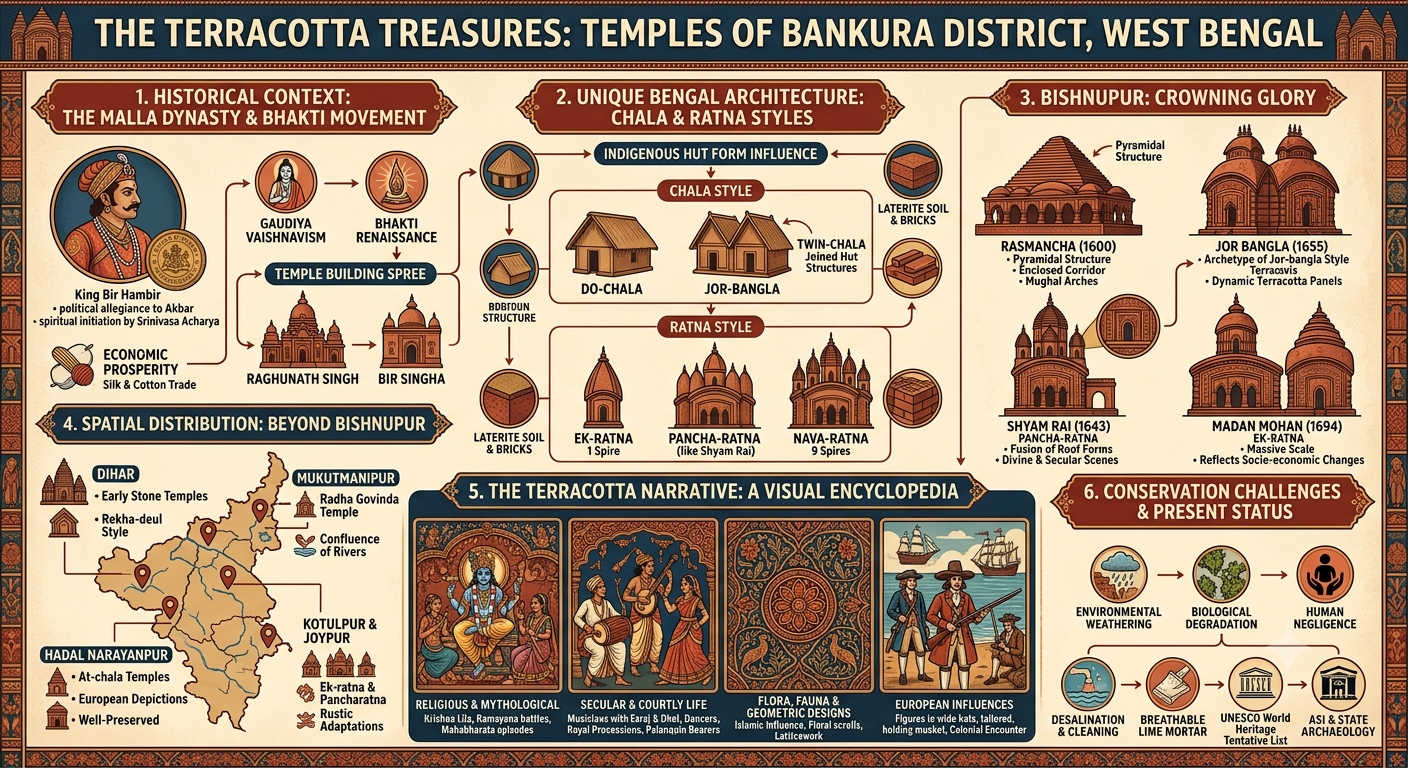
The genesis of Bankura’s temple architecture is inextricably linked to the rise of the Malla dynasty. The Mallas, originally a local tribal chieftaincy, established their capital at Bishnupur in the late medieval period, shedding their tribal affiliations to adopt Brahmanical Hinduism (McCutchion, 1972). The true architectural renaissance, however, began in the 17th century under King Bir Hambir (r. 1565–1620).
Bir Hambir’s political allegiance to the Mughal Emperor Akbar brought immense wealth and stability to Bishnupur. More importantly, his spiritual initiation into Gaudiya Vaishnavism by the revered saint Srinivasa Acharya transformed the religious landscape of the region. The Bhakti movement, with its emphasis on personal devotion to Krishna and Radha, necessitated new spaces for congregational worship (*kirtan*) and the housing of deities. Consequently, a massive temple-building spree was initiated by Bir Hambir and sustained by his successors, particularly Raghunath Singh (r. 1626–1656) and Bir Singha (r. 1656–1682) (Santra, 1998).
The economic prosperity of the Malla kingdom was fueled by the export of silk, cotton, and intricate terracotta artifacts. This mercantile wealth funded the employment of highly skilled artisans, potters, and architects, who formed guilds (*silpis*) and passed down their terracotta-crafting techniques across generations.
Architectural Typologies: The Evolution of the Bengal Style
The temples of Bankura exhibit a distinct architectural vocabulary that evolved indigenously, moving away from the North Indian *Nagara* and the Odishan *Rekha* styles, though early influences of the latter are visible. The standard Bengali temple is essentially a hut structure translated into brick and terracotta. David McCutchion (1972), the pioneering scholar on Bengali temples, categorized them broadly into two main typologies based on their roof structures: *Chala* and *Ratna*.
1. **The Chala Style:** This style mimics the traditional thatched bamboo huts of rural Bengal. The most common is the *Do-chala* (two-sided sloping roof), resembling a hut with a curved ridge. A more complex variation is the *Jor-bangla* (or *Twin-chala*), which consists of two *Do-chala* structures joined together, creating a unified, imposing facade. The famous Jor Bangla temple in Bishnupur is the archetype of this style.
2. **The Ratna Style:** This style involves a *chala* or a flat-roofed base (*atar-chala*) crowned with one or multiple ornate spires (*ratnas*) at the top. Thus, we have the *Ek-ratna* (one spire), *Pancharatna* (five spires), and *Navaratna* (nine spires) temples. The spires are typically octagonal or cylindrical and culminate in a kalasha (pot) finial.
3. **Laterite and Stone Precursors:** Before the mastery of terracotta brick, early temples in Bankura, such as the 10th-century Sidheshwari temple at Dihar, were built using dressed laterite stone, heavily influenced by the Odishan *Rekha-deul* style. These structures mark the architectural genesis from which the later terracotta marvels evolved.
Bishnupur: The Crowning Glory
Bishnupur is the epicenter of Bankura’s temple heritage, housing over a dozen major temples within a compact area. Each temple is a masterpiece of structural engineering and decorative art.
* **Rasmancha:** Built by Bir Hambir in 1600, the Rasmancha is unique in the architectural canon of Bengal. It is not a standard temple but a square, stepped pyramid structure with a central sanctuary surrounded by an enclosed corridor of elongated, pointed arches. It was constructed to exhibit the *Ras* icons of Radha-Krishna during the annual Ras festival. The arches show an early Mughal influence, adapted to a local Bengali context.
* **Jor Bangla Temple (c. 1655):** Erected by Raghunath Singh, this temple is the most celebrated example of the *Jor-bangla* style. The entire outer surface, from the curved cornices to the base plinth, is engulfed in terracotta panels. The panels depict scenes from the *Ramayana*, *Mahabharata*, and *Krishna Lila*, executed with astonishing dynamism and plasticity.
* **Shyam Rai Temple (c. 1643):** Built by Raghunath Singh, this is a *Pancharatna* temple set on a raised plinth. What makes the Shyam Rai exceptional is the fusion of architectural forms: the roof features both *dochala* and *jor-bangla* projections, crowned by five ratnas. The terracotta work here is highly ornate, featuring intricate floral scrolls, geometric patterns, and elaborate depictions of divine and secular life.
* **Madan Mohan Temple (c. 1694):** Built by Durjan Singh Dev, this *Ek-ratna* temple is one of the largest in Bishnupur. Its massive scale and the sheer volume of its terracotta ornamentation are overwhelming. The panels are notably distinct because they reflect the socio-economic changes of the late 17th century, including the presence of European soldiers, indicating the onset of colonial trade influences in the region (Michell, 1983).
Beyond Bishnupur: The Spatial Distribution of Temple Architecture
While Bishnupur is the focal point, the temple-building tradition permeated the entire Bankura district, supported by subordinate *zamindars* (landlords) who emulated the Malla court.
* **Dihar:** Located about 8 km from Bishnupur, Dihar houses two early stone temples—Saileswar and Sateshwar—dating back to the 10th-11th centuries. Built in the *Rekha-deul* style using chlorite and laterite, they represent the pre-terracotta phase of Bankura’s architectural history, linked to the Somavamsi dynasty.
* **Mukutmanipur:** At the confluence of the Kangsabati and Kumari rivers, the Radha Govinda temple (built in the 18th century by the Rajas of Ambika Nagar) is a striking *Pancharatna* structure. Though less ornamented than Bishnupur’s temples, it stands as a significant architectural landmark in the southern part of the district.
* **Hadal Narayanpur:** Located in the Bankura Sadar subdivision, this village contains a fascinating cluster of three *At-chala* (eight-roofed) temples built in the 18th-19th centuries by the Mondal family of *zamindars*. The terracotta here is exceptionally well-preserved, featuring highly stylized depictions of European soldiers with muskets, merchant ships, and elite women in contemporary attire, serving as a visual record of the colonial encounter (Guha-Thakurta, 1998).
* **Kotulpur and Joypur:** These regions feature several *Ek-ratna* and *Pancharatna* temples, such as the Radha Shyam temple at Kotulpur. They demonstrate the diffusion of the Bishnupur style into the rural hinterlands, albeit with slightly rustic, localized adaptations in the terracotta detailing.
The Terracotta Narrative: Iconography and Social History
The true brilliance of the Bankura temples lies in their terracotta panels. Terracotta (fired earth) was the perfect medium for the artisans—it was cheap, malleable, and could be baked into hard, durable modules that were then fixed onto the brick core of the temple.
The iconography of these temples transcends purely religious boundaries, functioning as a visual encyclopedia of 17th and 18th-century Bengali society. The panels are broadly categorized into three themes:
1. **Religious and Mythological Narratives:** The primary focus is on Vaishnavite theology. Scenes from the *Bhagavata Purana* dominate, depicting Krishna’s childhood (*Bala Lila*), the *Ras Lila* (cosmic dance), and his battles with demons. Equally prominent are episodes from the *Ramayana* (such as the golden deer, Sita’s abduction, and the battle with Ravana) and the *Mahabharata*. These panels served a didactic purpose, educating an often illiterate populace about Hindu epics.
2. **Secular and Courtly Life:** The artisans did not limit themselves to the divine. They meticulously carved scenes of contemporary life. Panels show musicians playing instruments like the *esraj* and *dhol*, dancers in graceful postures, and processions of elephants and horses. Hunting scenes, palanquin bearers, and royal court gatherings provide deep insights into the lifestyle of the Malla aristocracy.
3. **Flora, Fauna, and Geometric Designs:** The spandrels of arches and the cornices are heavily laden with intricate floral scrolls, lotus motifs, and geometric latticework, reflecting a strong Islamic aesthetic influence brought through Mughal contact.
4. **European Influences:** A fascinating aspect of the late 17th and 18th-century temples, particularly the Madan Mohan temple in Bishnupur and the temples at Hadal Narayanpur, is the depiction of Europeans. Artisans carved figures of men wearing wide-brimmed hats, tailored coats, boots, and holding flintlock guns or swords. Ships with European rigging are also visible. These panels indicate that the artisans were observing the changing world around them—Portuguese, Dutch, and British traders interacting with the local economy—incorporating these “exotic” elements into their sacred art (Eaton, 1993).
The Sacred Terrain: Ancient and Modern Temples of Jalpaiguri District, West Bengal
Conservation Challenges and Present Status
Despite their historical significance, the terracotta temples of Bankura face severe conservation challenges. The primary threat is environmental weathering. The porous nature of terracotta makes it highly susceptible to the salinity and moisture of the Bengal monsoon. Over centuries, this has led to the flaking, peeling, and structural weakening of the panels (Ghosh, 2005).
Furthermore, biological degradation caused by the growth of moss, lichen, and micro-organisms, coupled with human negligence, encroachment, and previous ill-conceived restoration attempts (such as cement plastering, which traps moisture and destroys the terracotta), has damaged several structures.
The Archaeological Survey of India (ASI) and the West Bengal State Archaeology Department have taken significant steps to mitigate this. Several temples in Bishnupur, including the Shyam Rai, Jor Bangla, and Rasmancha, are centrally protected monuments. Modern conservation practices now emphasize desalination, mechanical cleaning, and the use of breathable lime mortar for structural repairs. Additionally, the inclusion of Bishnupur in the UNESCO World Heritage Tentative List has brought international attention to the need for sustainable conservation and tourism management.
Conclusion
The temples of Bankura district are far more than remnants of a bygone era; they are living monuments of human ingenuity and cultural synthesis. Born from the synthesis of indigenous Bengali hut architectures, Odishan stone-building traditions, Mughal arches, and Vaishnavite devotional fervor, they represent a unique architectural idiom that found its ultimate expression in baked earth.
Through the meticulous terracotta carvings, the silent walls of Bankura speak volumes—narrating tales of gods and goddesses, detailing the grandeur of Malla courts, and recording the subtle shifts in society as European merchants arrived on the shores of Bengal. Preserving these terracotta treasures is not merely an architectural necessity but a vital endeavor to safeguard the visual and cultural memory of Bengal. As scholars and conservationists continue to study and protect these structures, the temples of Bankura will undoubtedly continue to inspire awe, serving as a bridge between the mundane earth from which they were molded and the divine heavens they were built to represent.
References
1. Eaton, R. M. (1993). *The Rise of Islam and the Bengal Frontier, 1204-1760*. University of California Press.
2. Ghosh, P. (2005). “Conservation of Terracotta Temples of West Bengal: Challenges and Strategies.” *Journal of Architectural Conservation*, 11(2), 53-72.
3. Guha-Thakurta, T. (1998). “Making of a New ‘Indian’ Art: Artists, Artisans and the Nationalist Terrain in Colonial India (c. 1850-1900).” In *Art and Visual Culture in India*, 1850-1900. Marg Publications.
4. McCutchion, D. (1972). *Late Medieval Temples of Bengal: Origins and Classification*. Asiatic Society, Calcutta.
5. McCutchion, D., & Das, G. (1974). *Temples of Bankura District*. Asiatic Society, Calcutta.
6. Michell, G. (1983). “The Brick Temples of Bengal.” In *The Islamic Heritage of Bengal*. UNESCO.
7. Santra, T. (1998). *Bankurar Itihas O Sanskriti* [History and Culture of Bankura]. Progressive Publishers, Calcutta. (In Bengali).
8. West Bengal State Archaeology & Museums. (n.d.). *Bankura District: Archaeological Gazetteer*. Government of West Bengal.
Saunak Roy Chowdhury
Also Read : বাঁকুড়া জেলার বিবরণ

