
Introduction: A Historical Moment Beyond a Calendar Date
History is not merely a sequence of events; it is a collective memory shaped by struggles, decisions, and the aspirations of communities. Certain dates acquire significance because they represent moments when the destiny of societies is transformed. (Paschimbanga Dibas)
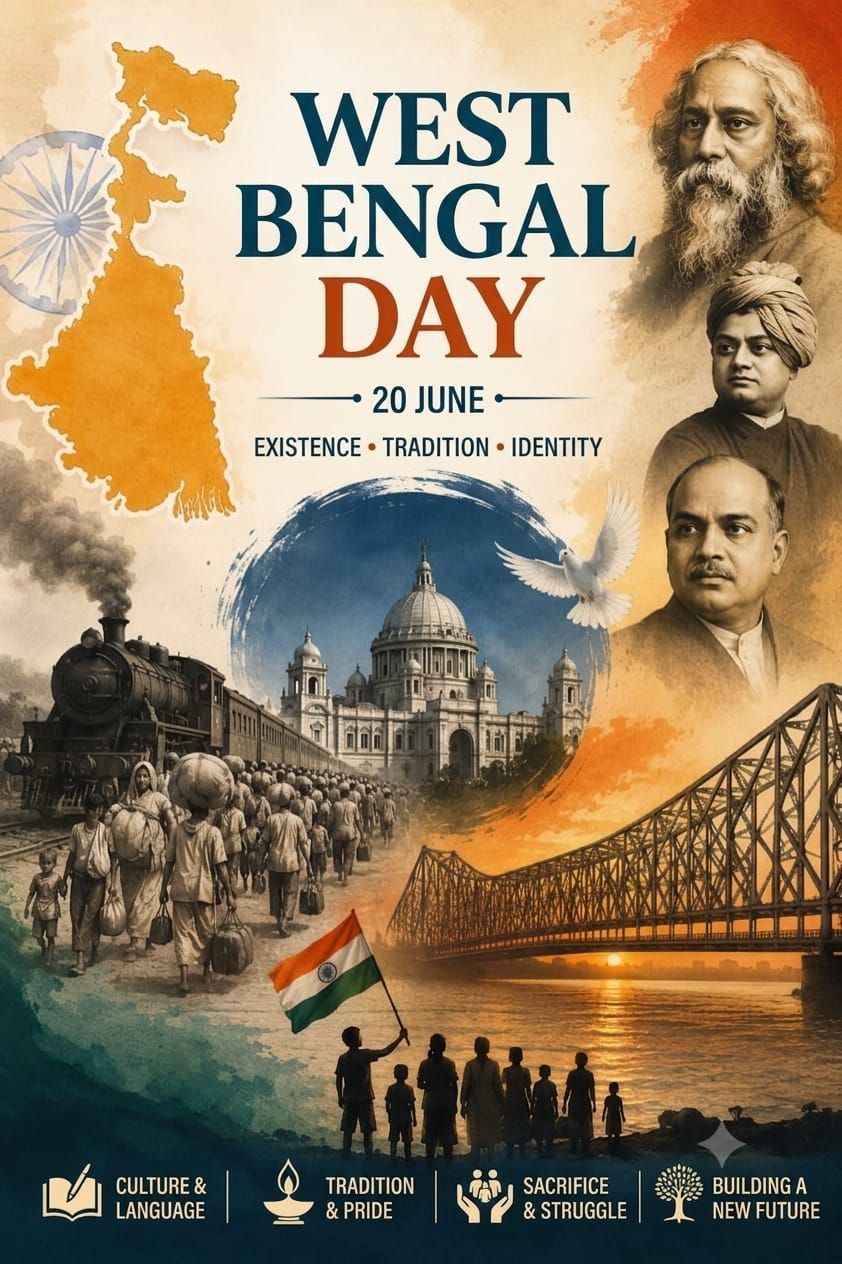
20 June 1947 remains one such defining moment in the history of Bengal. Observed as Paschimbanga Dibas, the day marks the historic decision of the Bengal Legislative Assembly that paved the way for the creation of the state of West Bengal within independent India.
The significance of Paschimbanga Dibas extends beyond the formation of a provincial boundary. It represents the culmination of a political struggle concerning cultural identity, demographic realities, constitutional choices, and the preservation of a distinct Bengali civilisational heritage during one of the most turbulent phases of Indian history.
From the perspective of Bengali Hindu historical consciousness, the creation of Paschimbanga symbolised the preservation of a homeland where Bengali language, cultural traditions, and intellectual heritage could continue to flourish within the Indian Union. At the same time, it remains inseparably linked with the tragedy of Partition, displacement, and the human cost of political division.
Historical Context: Bengal in the Late Colonial Period
Bengal occupied a unique position in the intellectual and cultural history of India. It was the centre of the Bengal Renaissance and played a pioneering role in social reform, literature, education, and nationalist thought.
The contributions of figures such as Raja Rammohan Roy, Ishwar Chandra Vidyasagar, Bankim Chandra Chattopadhyay, Swami Vivekananda, Rabindranath Tagore, and many others shaped the modern Bengali identity.
However, by the 1940s, Bengal’s political landscape had undergone significant transformation. The growth of communal politics, separate electorates, and debates over representation created a complex environment where questions of political power and cultural security became increasingly important.
The future of Bengal became one of the central questions during the final phase of British rule.
The Constitutional Process of 20 June 1947: The Formation of Paschimbanga
The announcement of the Mountbatten Plan on 3 June 1947 initiated the process of Partition. The future of Bengal was to be determined through the Bengal Legislative Assembly.
On 20 June 1947, the Assembly conducted a historic constitutional exercise through three separate sessions.
The Undivided Bengal Session
The first session considered whether the entire province of Bengal would join the Indian Constituent Assembly. The proposal was defeated, indicating that undivided Bengal would not remain part of India.
The Western Bengal (Hindu-majority Areas) Session
Representatives from the Hindu-majority districts met separately and voted in favour of the partition of Bengal. The decision was:
58 votes in favour and 21 against.
This vote became the constitutional foundation for the creation of Paschimbanga and its inclusion within India.
The Eastern Bengal (Muslim-majority Areas) Session
Representatives from Muslim-majority districts opposed the partition of Bengal and subsequently moved towards joining Pakistan as East Bengal.
Thus, through a legislative process, the political future of Bengal was determined.
Dr Shyama Prasad Mukherjee and the Political Movement for Paschimbanga
The role of Dr Shyama Prasad Mukherjee remains one of the most discussed aspects of the creation of Paschimbanga.
Initially, Mukherjee opposed both the division of India and Bengal. However, when Partition became inevitable, he argued that if India was being divided on the basis of religious majority, the same principle had to apply to Bengal.
His concern was that if the entire province of Bengal became part of Pakistan, the political security and cultural continuity of Bengali Hindus would be threatened.
He opposed the proposal of an independent United Bengal, arguing that such an arrangement would not adequately protect the interests of the Hindu-majority western districts.
His political argument centred around the preservation of:
-
Bengali cultural heritage,
-
constitutional security,
-
economic stability,
-
and the continuation of Bengal’s intellectual traditions.
For his supporters, Mukherjee’s role represented a struggle for the survival of Bengali Hindu cultural identity during an existential political crisis.
Boundary Formation and the Geographical Consolidation of Paschimbanga
The Radcliffe Boundary Commission faced the difficult task of dividing Bengal based on demographic, administrative, and economic considerations.
Several districts became central to the boundary debate, including:
-
Nadia,
-
Malda,
-
Murshidabad,
-
Dinajpur.
These regions carried historical, cultural, and strategic importance.
The future of Kolkata was particularly significant because it was the economic centre of Bengal, with its port, industries, and administrative importance.
The final boundary settlement ensured that important regions remained within India, giving Paschimbanga a viable geographical and economic structure.
Partition, Displacement and the Reconstruction of Society
The creation of Paschimbanga was accompanied by one of the largest human migrations in modern history.
Millions of people from East Bengal crossed into India, leaving behind their ancestral homes due to political uncertainty, communal tensions, and insecurity.
The refugee communities that emerged in West Bengal played a transformative role in shaping the state’s future.
They contributed significantly to:
-
education,
-
entrepreneurship,
-
literature,
-
culture,
-
social movements,
-
and urban development.
The modern identity of Paschimbanga was therefore shaped not only by political decisions but also by the resilience of ordinary people.
Cultural Identity and the Civilisational Significance of Paschimbanga
From a Bengali Hindu historical perspective, Paschimbanga represented the continuation of a cultural homeland where the traditions of Bengal’s Renaissance could survive within India.
The state inherited the intellectual legacy of:
-
Bengali literature,
-
social reform movements,
-
spiritual traditions,
-
artistic expressions,
-
and linguistic heritage.
The creation of Paschimbanga ensured the continuation of these traditions in a political environment where they could evolve freely.
At the same time, the cultural identity of Bengal has historically been pluralistic, shaped by centuries of interaction among different communities and traditions.
Historical Memory and Contemporary Relevance
Paschimbanga Dibas remains a subject of historical discussion because Partition itself carries multiple memories.
For many, it represents the pain of division and displacement.
For others, it represents the preservation of cultural identity and the establishment of a secure political homeland.
A balanced historical understanding must acknowledge both dimensions.
The creation of Paschimbanga was born out of a tragic historical circumstance, but it also became a story of reconstruction, adaptation, and cultural continuity.
Conclusion: Paschimbanga Dibas as a Symbol of Identity and Resilience
Paschimbanga Dibas is not merely a commemoration of the formation of a state. It represents a crucial chapter in the history of Bengal—where questions of identity, geography, culture, and political survival intersected.
It reminds us of:
-
the constitutional process that shaped Bengal’s destiny,
-
the sacrifices of displaced communities,
-
the preservation of cultural heritage,
-
and the resilience of a society rebuilding itself after Partition.
The history of Paschimbanga is therefore not only a story of division but also a story of continuity, survival, and renewal.
Aritra Ghosh Dastidar
Read Also : From Christmas to Kalpataru : How Sri Ramakrishna Rewrote the Colonial Calendar
Celebration of Pashchimbanga Dibas
References and Sources
-
Bengal Legislative Assembly Debates (1947)
Proceedings of the Bengal Legislative Assembly regarding the Partition of Bengal, 20 June 1947. -
Transfer of Power Papers, Volume XII: The Mountbatten Viceroyalty — Formulation of a Plan, 22 March–30 May 1947
Published by Her Majesty’s Stationery Office, UK Government archives. -
R.C. Majumdar, History of Modern Bengal
Provides historical analysis of Bengal’s political and cultural developments. -
Joya Chatterji, Bengal Divided: Hindu Communalism and Partition, 1932–1947
Cambridge University Press, 1994. -
Nehru Memorial Museum and Library Archives
Documents relating to Partition, Shyama Prasad Mukherjee, and Bengal politics. -
Government of India, The Indian Independence Act, 1947
Constitutional framework for the creation of India and Pakistan. -
Ayesha Jalal, The Sole Spokesman: Jinnah, the Muslim League and the Demand for Pakistan
Cambridge University Press, 1985. -
Hiranmay Banerjee, writings on Partition and Bengali refugee history
Studies on displacement and rehabilitation in post-Partition Bengal.

