
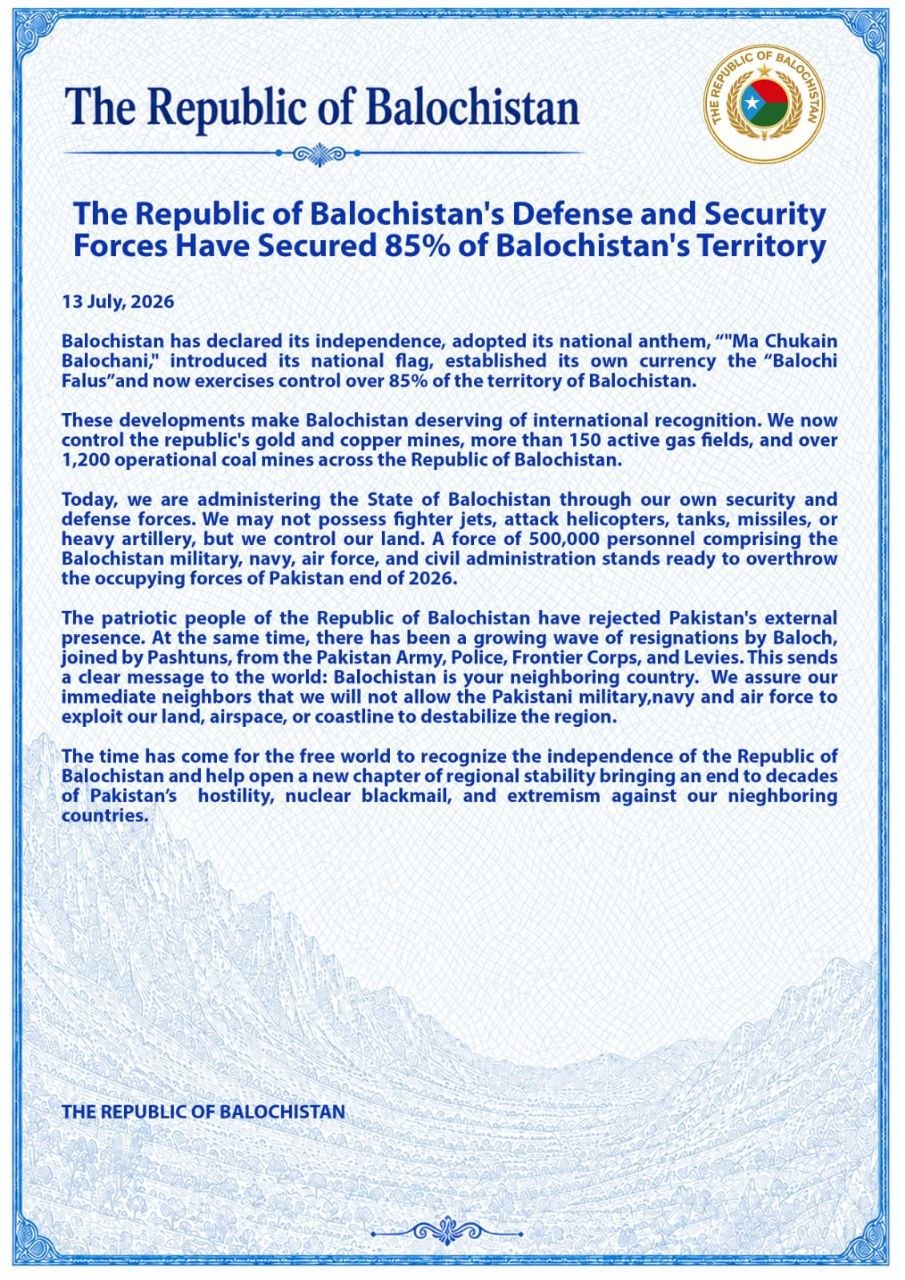
The announcement by a group identifying itself as the Republic of Balochistan, claiming control over 85% of the territory, the adoption of a national flag, anthem, currency, and the establishment of parallel governing institutions, has once again brought the Baloch question into the centre of South Asian strategic discourse. While such declarations have circulated before, the scale and confidence of the present claims inevitably invite comparisons with one of the most consequential events in modern South Asian history—the birth of Bangladesh in 1971. (Balochistan and Bangladesh 1971)
Yet history rarely repeats itself in identical form. The comparison is instructive, not because the two cases are the same, but because they illuminate the conditions under which states fracture, nations emerge, and regional power balances shift.
The Bangladesh Precedent
The emergence of Bangladesh was neither accidental nor sudden. It followed decades of political exclusion, linguistic discrimination, economic disparities, and military repression by West Pakistan against East Pakistan.
The watershed moment came after the 1970 general elections when the Awami League, led by Sheikh Mujibur Rahman, secured an overwhelming democratic mandate but was denied the right to govern. The subsequent military crackdown under Operation Searchlight on 25 March 1971 triggered widespread resistance, leading to the Bangladesh Liberation War.
India initially faced a humanitarian catastrophe as nearly ten million refugees crossed into its territory. Diplomatic efforts failed to halt the violence, and after months of escalating conflict, India intervened militarily in December 1971. Within thirteen days, Pakistani forces surrendered in Dhaka, resulting in the creation of Bangladesh.
The crucial lesson from 1971 is that Bangladesh achieved international recognition not merely because independence was declared, but because effective territorial control, representative political leadership, humanitarian concerns, and international diplomacy converged to create a new geopolitical reality.
Understanding the Contemporary Baloch Movement
Balochistan has witnessed insurgencies almost continuously since Pakistan’s independence in 1947. Baloch nationalist groups have long alleged political marginalization, unequal resource distribution, enforced disappearances, and extensive military operations by Pakistani security forces.
The latest declaration goes significantly beyond previous statements. It claims:
* control over 85% of Balochistan;
* functioning military and civil administrative institutions;
* a national anthem and flag;
* a proposed national currency;
* authority over strategic mineral and energy resources.
If accurate, these developments would represent an unprecedented shift in the conflict. However, many of these claims remain independently unverified at the time of writing, and there is no international consensus confirming the extent of territorial control or governmental capacity. Analysts should therefore distinguish between political declarations and verified facts.
Similarities with 1971
Several structural similarities explain why observers instinctively compare Balochistan with Bangladesh.
First, both movements emerge from longstanding perceptions of political exclusion within Pakistan.
Second, both regions possess significant economic resources while claiming inadequate political representation and uneven development.
Third, both conflicts have witnessed allegations of extensive military operations against local populations.
Fourth, each movement seeks international legitimacy by presenting itself not merely as an insurgency but as the representative of an aspiring sovereign nation.
Finally, both cases carry profound strategic implications for India due to geography, security, and regional stability.
The Critical Differences
Despite these similarities, major differences separate the two cases.
Democratic Legitimacy
Bangladesh emerged after a decisive electoral mandate. The Awami League had won Pakistan’s first national election, giving its leadership clear democratic legitimacy.
No comparable electoral mandate currently exists for Baloch nationalist organizations across Pakistan’s Balochistan province.
International Recognition
During 1971, evidence of mass atrocities generated substantial international attention despite Cold War divisions.
At present, no major power has formally recognized an independent Republic of Balochistan.
Military Balance
In 1971, Pakistan fought a conventional war against India, one of the region’s strongest militaries.
The Baloch movement presently confronts Pakistan largely without comparable external military support.
Humanitarian Context
Bangladesh’s liberation was accompanied by one of the largest refugee crises in modern history, directly affecting India.
Although human rights organizations have documented concerns in Balochistan over many years, the present situation differs significantly in scale and international response.
Why Balochistan Matters to India
From India’s strategic perspective, Balochistan occupies exceptional importance.
It borders Iran and Afghanistan while overlooking the Arabian Sea. The province contains substantial reserves of natural gas, copper, gold, coal, and other critical minerals. It is also home to the deep-sea port of Gwadar, a central component of the China–Pakistan Economic Corridor (CPEC) and China’s broader Belt and Road Initiative.
Any prolonged instability in Balochistan could influence:
* India’s western maritime security;
* Chinese strategic investments;
* Pakistan’s internal cohesion;
* energy supply routes;
* regional counter-terrorism dynamics.
For New Delhi, therefore, developments in Balochistan are not merely an internal Pakistani issue but a matter of regional strategic significance.
International Law and the Recognition Question
Under the Montevideo Convention (1933), statehood is generally assessed against four criteria:
1. a permanent population;
2. a defined territory;
3. an effective government;
4. the capacity to enter into relations with other states.
Meeting these conditions does not automatically guarantee recognition. Recognition remains fundamentally a political decision by sovereign states, influenced by strategic, legal, and diplomatic considerations.
Thus, declarations of independence alone do not create internationally recognized states.
India’s Diplomatic Calculus
India’s approach is likely to remain cautious.
New Delhi has historically emphasized respect for territorial sovereignty while simultaneously raising concerns regarding cross-border terrorism and human rights.
Unlike 1971, the current international environment is far more complex. China’s extensive investments in Pakistan, evolving regional alignments, nuclear deterrence, and global concerns regarding state fragmentation all encourage diplomatic restraint.
India is therefore more likely to closely monitor developments, strengthen border security, engage multilaterally where appropriate, and calibrate its responses according to verified developments rather than political declarations.
Could History Repeat Itself?
The comparison between Bangladesh in 1971 and Balochistan in 2026 is intellectually compelling but analytically incomplete.
Bangladesh demonstrated that sustained political exclusion, military repression, and humanitarian catastrophe can culminate in state formation when supported by effective governance, territorial control, and international legitimacy.
Whether Balochistan is following a comparable trajectory remains uncertain. Much depends on independently verified control of territory, the cohesion of Baloch political leadership, Pakistan’s response, regional diplomacy, and the evolving positions of major powers.
Conclusion
For India, the Baloch question should neither be viewed through the lens of triumphalism nor dismissed as mere rhetoric. Instead, it deserves rigorous academic scrutiny grounded in international law, regional security, and historical experience.
The events of 1971 transformed South Asia because political aspirations converged with geopolitical realities. Whether Balochistan will become another watershed moment remains an open question. As of now, the prudent analytical position is to distinguish between declarations and verified developments while recognizing that any significant change in Balochistan’s status would have profound implications for the future strategic architecture of the Indian subcontinent.
The lessons of history suggest that unresolved questions of identity, governance, and political inclusion rarely disappear. They evolve—and occasionally redefine the map itself.
Aritra Ghosh Dastidar
Also Read : Paschimbanga Dibas: Historical Origins, Political Context and the Evolution of Bengali Identity
Balochistan declares Independence
Selected References
- Bass, Gary J. The Blood Telegram: Nixon, Kissinger, and a Forgotten Genocide. Alfred A. Knopf, 2013.
- Cohen, Stephen P. The Idea of Pakistan Brookings Institution Press, 2004.
- Harrison, Selig S. In Afghanistan’s Shadow: Baluch Nationalism and Soviet Temptations Carnegie Endowment for International Peace, 1981.
- Jalal, Ayesha. The Struggle for Pakistan: A Muslim Homeland and Global Politics Harvard University Press, 2014.
- Raghavan, Srinath. 1971: A Global History of the Creation of Bangladesh Harvard University Press, 2013.
- United Nations. Charter of the United Nations (1945).
- Montevideo Convention on the Rights and Duties of States (1933).
Note: Contemporary claims regarding the “Republic of Balochistan” are based on publicly available statements by Baloch nationalist groups and Passive OSINT and remain independently unverified at the time of writing.

