Mymensingh (Bhaluka), Bangladesh | December 2025
Blasphemy allegations have become a deadly instrument of persecution in Bangladesh—one that increasingly places religious minorities in mortal danger. On the night of December 18, 2025, this reality culminated in one of the most horrifying acts of communal violence in recent months. (Blasphemy as a License to Kill)
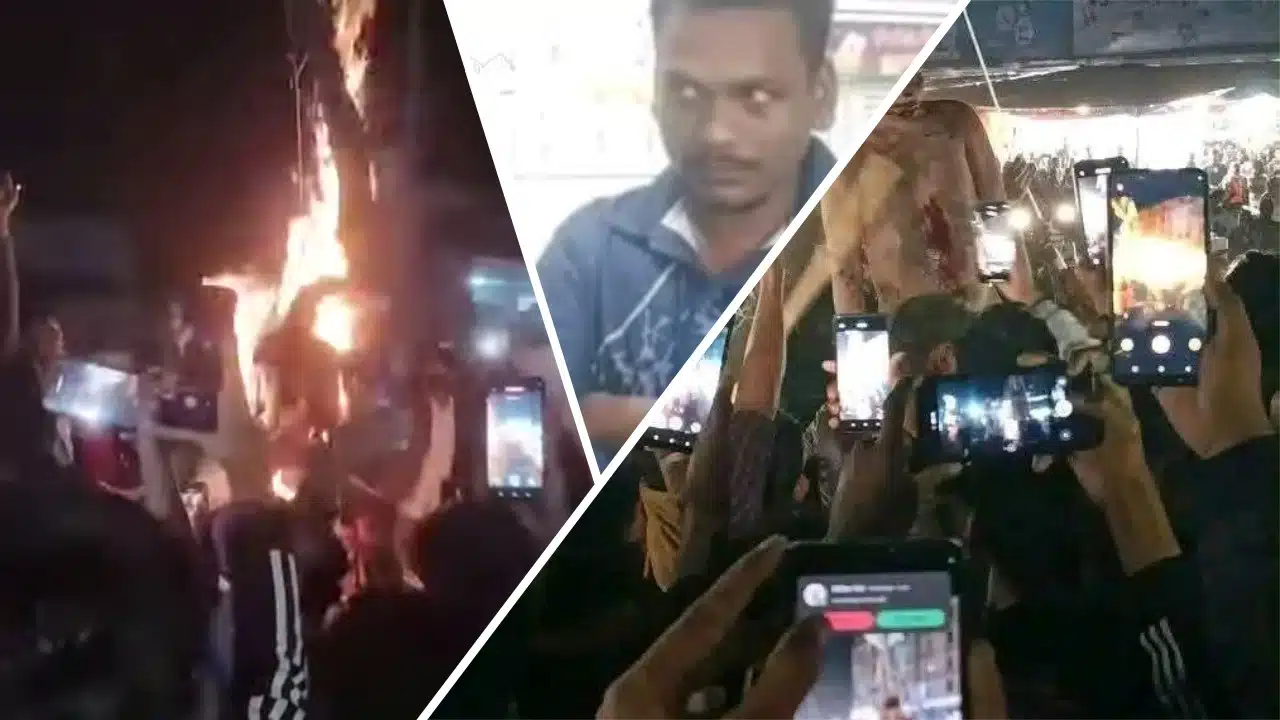
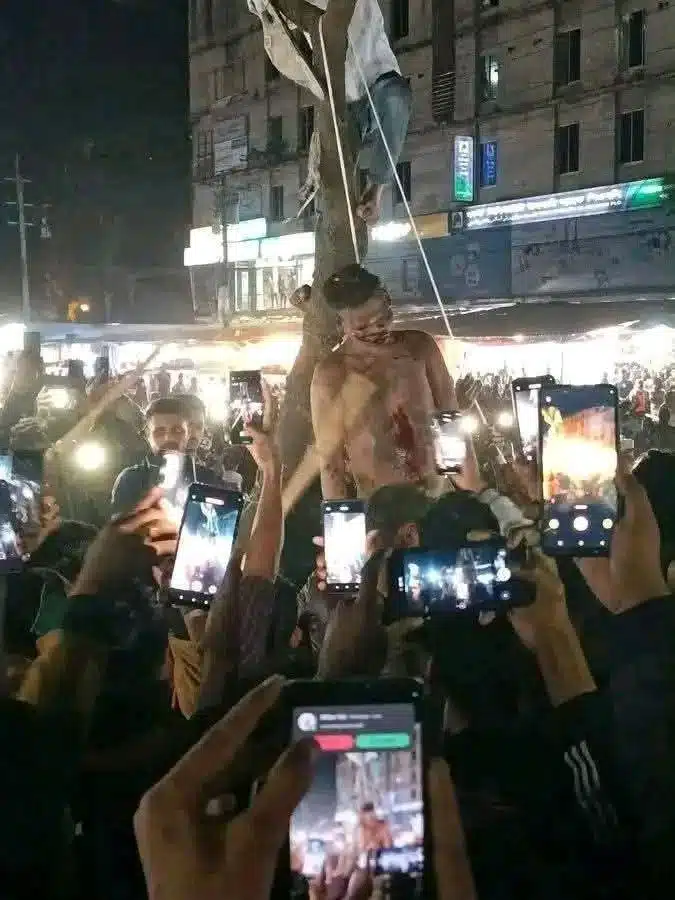
Dipu Chandra Das, a Hindu garment-factory worker and the sole earning member of his family, was dragged out of his workplace in Bhaluka upazila of Mymensingh following an unverified and allegedly false accusation of blasphemy. What followed was not disorder, nor any form of justice. It was a mob lynching that escalated into burning—an act of communal execution carried out in public view.
Upon receiving initial reports of violence, Advocate Lucky Bacchar, Convenor of HRCBM Bangladesh, immediately contacted the Officer-in-Charge (OC) of the local police station to seek urgent intervention. An audio recording of this conversation, documenting the exchange between the OC and Advocate Bacchar, has been uploaded and presented above as part of HRCBM’s evidence-based reporting. The Officer-in-Charge stated that police had received a call from the Pioneer Factory administration reporting that an angry mob had gathered and was attacking the factory, alleging that Dipu Chandra Das, a worker at the factory, had made blasphemous remarks. The OC said officers responded immediately, but while en route received information that the mob had already dragged Dipu Chandra Das out of the factory premises.

In the police account, Dipu Chandra Das was lynched in front of the Pioneer factory gate and died on the spot. The OC further stated that the mob then marched with the body to the main road, where slogans were shouted and the body was set on fire. The crowd was estimated at 5,000 to 6,000 people, and it reportedly took approximately one hour, with assistance from the army, for authorities to recover the body and transfer it to the morgue.
This official narrative is contested by eyewitness testimonies gathered by HRCBM field observers, which indicate that Dipu Chandra Das may have been alive or not fully deceased when he was set on fire, and that intervention to save him was delayed or absent at a critical moment. HRCBM is continuing to verify these eyewitness accounts and has not reached a final determination while preparing this report.
Eyewitness statements documented by HRCBM’s local field network, and corroborated by multiple media reports, place the attack at around 9:00 PM in the Masterbari–Dubalia Para area near the factory where Dipu was employed. The body was subsequently taken to the Dhaka–Mymensingh highway, where further unrest followed, traffic was disrupted, and panic spread through the area.
A Crime That Reflects a National Pattern
The killing of Dipu Chandra Das is not an isolated incident. It reflects a systemic and accelerating pattern in which blasphemy allegations are weaponized to terrorize, dispossess, and eliminate minority citizens.
On December 5, 2025, the Human Rights Congress for Bangladesh Minorities (HRCBM) publicly warned that Bangladesh is facing a deepening human rights crisis driven by the misuse of blasphemy allegations. Based on nationwide field documentation and police verification, HRCBM reported that between January and November 2025 (Please click here for full Report):
-
78 blasphemy-related incidents targeted minority individuals and communities across 32 districts
-
40 cases were formally filed with police (case numbers verified)
-
5 incidents involved police refusal to register complaints
-
5 students were expelled from educational institutions following allegations
-
23 cases remain under investigation
-
Thousands of families were affected through violence, displacement, loss of livelihood, or social ostracization
A significant number of these cases involved fabricated or manipulated digital evidence, including hacked social media accounts, fake screenshots, impersonation, or unverified online posts, often leading to arrests or mob violence without any cyber-forensic verification.
Dipu Chandra Das now becomes one of the most tragic symbols of this pattern—where an allegation alone is enough to destroy a life.
From Allegation to Communal Execution: A Pattern of Silent Erasure
The killing of Dipu Chandra Das did not merely violate individual criminal statutes; it violated the very foundations of Bangladesh’s constitutional order and its binding international obligations. The deliberate lynching and subsequent burning of a human being—whether alive or post-mortem—constitute grave crimes in themselves. To isolate debate solely around the act of burning is therefore legally and morally inadequate; the entire sequence represents a total collapse of the rule of law.
What unfolded in Bhaluka reflects a recurrent and deeply alarming pattern:
-
An allegation replaces evidence, bypassing investigation or verification
-
A crowd supplants law-enforcement and the judiciary, assuming the power to punish
-
Violence is transformed into public spectacle, normalizing brutality
-
Minority identity becomes grounds for collective punishment, not individual accountability
This was not “mob justice.” It was mob vigilantism culminating in communal execution—an extrajudicial killing carried out under a false religious pretext, intended not only to kill one man, but to terrorize an entire minority community into submission and silence.
Such acts represent serious social and institutional decay. When repeated with impunity, they do not remain isolated crimes; they become signals, teaching both perpetrators and victims that minority lives are dispensable, and that violence will be tolerated or excused. In this context, the failure to intervene swiftly, investigate impartially, and punish perpetrators to the fullest extent of the law is not neutrality—it is acquiescence.
If forensic findings establish that Dipu Chandra Das was burned while still alive or not fully deceased, the crime would amount to aggravated murder involving torture, prohibited under:
-
Article 32 of the Constitution of Bangladesh (Right to Life)
-
The International Covenant on Civil and Political Rights (ICCPR)
-
The Convention Against Torture (CAT), to which Bangladesh is a State Party
Even if death occurred prior to burning, the public desecration of his body constitutes an act of collective terror, deliberately staged to instill fear far beyond a single victim.
Taken together with dozens of similar blasphemy-related incidents documented across the country, these crimes reveal more than sporadic lawlessness. They depict a slow, silent, and systematic process of minority erasure—one in which killings, displacement, false cases, and social terror accumulate over time. International law recognizes that genocide and crimes against humanity need not occur through mass slaughter alone; they can unfold through persistent patterns of persecution, where the state fails to protect, fails to prosecute, and thereby allows destruction “in part” of a protected group.
If this trajectory is not urgently reversed, the erasure of minorities in Bangladesh will not be a distant fear—it will be an eventual certainty. Continued state passivity does not merely fail minorities; it accelerates their disappearance from the civic, cultural, and social fabric of the nation.
HRCBM’s Urgent Call to Prevent Irreversible Harm
In light of the killing of Dipu Chandra Das—and the broader, well-documented pattern of blasphemy-driven violence—HRCBM warns that incremental or symbolic responses are no longer sufficient. Immediate, structural intervention is required to prevent further loss of life and the progressive erasure of minority communities.
HRCBM therefore calls for:
-
Mandatory cyber-forensic verification before any arrest, detention, or public disclosure in alleged blasphemy cases
-
Criminal prosecution of individuals who fabricate digital evidence, incite mobs, or knowingly spread false allegations
-
Binding police protocols requiring early intervention and dispersal of mobs at the first sign of collective violence
-
An independent review of all blasphemy cases filed against minorities since 2024, with public disclosure of outcomes
-
Legal and procedural reform to explicitly prohibit vigilante violence and prevent religious allegations from being weaponized as instruments of collective punishment
Without these measures, each new incident compounds impunity—and brings the country closer to irreversible social rupture.
In Memory of Dipu Chandra Das
Dipu Chandra Das was not a criminal.
He was a worker, a son, and the sole provider for his family—an ordinary citizen entitled to the full protection of law.
He was accused without proof, removed from his workplace, lynched by a mob, and set on fire. Whether death occurred before or during the burning, the meaning of the act remains unchanged: impunity has emboldened brutality, and minority lives have been rendered expendable.
Source of this Report is here.
Read also : https://sritiochetona.org/selective-silence-in-bangladesh-violence-videos-and-vigilance-in-bangladesh/