
When foreign powers cast their shadow over the sacred soil of Bharat, resistance did not always emerge from great capitals or imperial thrones. Often, it rose from the quiet courage of chieftains who stood like dharmic fortresses, humble in scale but mighty in spirit. One such forgotten bastion was Chanduary Raj, a Hindu chieftaincy centered at Bharko village in present-day Banka district of Bihar, founded in 1599 A.D. by Chaturbhuj Chaudhary, a scion of the illustrious Yadava-Varman dynasty (Chanduary Raj).
Ancestral Lineage and the Rise of Chanduary Raj
The Chaudharies of Bharko belonged to the Majhraut clan of Ahirs and traced their origin to Samalavarman, a ruler of the Yadava-Varman dynasty mentioned in the Belava copperplate inscription. It is after him that their mool (gotra) came to be known as Samala. This dynasty once ruled vast swathes of Anga, Vanga, and Pundrabhukti, regions spanning modern Bihar, Bengal, Jharkhand and extended influence even to Orissa, as evidenced by epigraphs found in Bhubaneswar.
The Varman kings traced their origin to a Yadava dynasty of Simhapura and described themselves as kinsmen of Bhagwan Krishna. As recorded in the Belava copperplate inscription, they were devout followers of Vaishnav Dharma, embodying their faith through both spiritual devotion and martial valor. Jatavarman, one of the early rulers of the dynasty, expanded the kingdom through a series of conquests, and his successors — Harivarman, Samalavarman, and Bhojavarman — continued the lineage. Although the historical record falls silent after Bhojavarman, the rise of the Sena dynasty, whose inscriptions were later issued from Vikrampura, suggests that the Varmans were eventually displaced from imperial power. According to scholar A.K. Chaudhary, the Varman lineage declined to the position of local chiefs following the loss of their imperial authority during the Sena and Turkic-Afghan periods. He links the Chaudharis of Bharko to the imperial Varman line through their association with the Samala mool, believed to originate from Samalavarman. I concur with this view and would further suggest that the emergence of Chaturbhuj Chaudhary in the late 16th century marked the revival of this ancestral line, as he reclaimed a part of the former Varman domain and established Chanduary Raj in 1599 A.D.
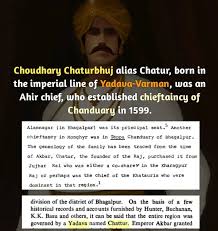
As historical records indicate, Chaturbhuj acquired two tappas — Chanduary and Chandipa — from a local debtor named Jujhar Rai, having earlier settled his arrears to the Mughal treasury. In recognition of this transaction, Chaturbhuj received a sanad from the imperial court, granting him administrative autonomy and the authority to govern in his own name and seal.
Resistance Against the Mughals
First Rebellion: The Uprising of Helmani Chaudhary (1656–57)
The true strength of Chanduary Raj was not just in landholding, but in its willingness to resist imperial domination, even when outmatched in power and resources.
In 1656–57, as confusion and anarchy gripped Bihar during the Mughal civil war between Shah Jahan’s sons, the imperial hold over the region weakened. Taking advantage of the moment, Helmani Chaudhary, great-grandson of Chaturbhuj, led a large-scale uprising against the Mughal administration. He raised an army of over 5,000 soldiers, comprising Hindu Ahirs, Rajputs, and some local tribal groups from the surrounding areas.
Helmani struck at Mughal interests by plundering parts of Bhagalpur, directly challenging Shah Shuja, the Subahdar of Bihar. Though Shuja was preoccupied with the larger Mughal succession struggle, he could not ignore the Chanduary rebellion, as it threatened his control over Sarkar Munger, especially with Chanduary falling under Bhagalpur, and his seat at Munger Fort being nearby. To suppress the uprising, Shuja dispatched Raja Bihroz of Kharagpur, the most powerful local chief in Sarkar Munger.
In the ensuing encounters, Bharko, the Chanduary stronghold, suffered heavy losses, and the original sanad granted under Akbar was destroyed. Despite this, the Chanduary resistance continued through guerilla tactics, keeping Mughal-aligned forces under constant pressure.
Meanwhile, as Mir Jumla advanced and decisively defeated Shuja, the political tides turned. With Shuja ousted and Kharagpur aligning with Jumla, the Mughals shifted to diplomatic measures to restore order. By this time, Helmani had passed away, and his eldest son Khemkaran Chaudhary emerged as the new leader. Seeking peace, the Mughal officer Saiyyed Ajmeri issued a fresh sanad in Khemkaran’s name, restoring the family’s ancestral holdings and reaffirming their hereditary rights.
Second Rebellion: Aligning with Marathas for Swaraj
The Chaudharis of Chanduary once again took a stand during the reign of Aurangzeb, as Mughal campaigns against Hindu powers intensified across India. During this period, Jainarayan Chaudhary, then the chieftain of Chanduary, made a significant decision to extend support to Marathas led by Chhatrapati Shivaji Maharaj and later his son for Hindu Swaraj.
Under his orders, his military commander and kinsmen Dhanaram Chaudhary led a strong force of around 3,000 soldiers from Bihar to the Deccan, where they joined the Maratha resistance against Mughal expansion. Dhanaram remained in the south for several years, actively participating in the Maratha campaigns, a notable but often overlooked instance of pan-Indian Hindu military solidarity.
Upon returning to Bharko, Dhanaram granted over 2,200 bighas of land in mauza Sonpai and Rutpai to the families of those who had died in the Deccan expedition.
Guardians of Dharma: Religious Patronage by Chaudharies:
The Chaudharis of Chanduary, who shared racial and ancestral affinity with the Yadava-Varman lineage, were known not only for their valor in warfare, but also for their deep commitment to Dharma. They remained equally devoted to Lord Vishnu.
In 1759, Gopavanshbhushan Hemnarayan Chaudhary and Dhanaram Chaudhary made a notable religious donation of 1,265 bighas of land specifically for Vishnu worship — a tradition referred to as Vishnuprīti. Such acts were not isolated. Over generations, the family consistently extended patronage to Brahmins, temple priests, and sādhus from renowned tīrthas across Bharat, reflecting their role in sustaining the Sanātan ecosystem, where land, wealth, and authority were used in service of Dharma rather than personal ambition.
Enduring Legacy, Lost in History:
Even under British rule, long after their military strength had declined, the Chaudharis of Chanduary continued to wield local authority and social respect. A letter from a 19th-century British Collector attests to their role in maintaining law and order, indicating that their judicial influence persisted for some time despite colonial constraints.
The estate’s last zamindar, Babu Raghunandan Prasad Chaudhary, actively participated in the freedom movement and remained a respected figure in post-Independence Bihar. Yet, like many such regional dharmic dynasties, the history of Chanduary faded from public memory — overshadowed by Delhi-centric narratives that often ignored smaller but significant contributors to India’s political and cultural landscape.
Read Also : Temples of Purulia from Pala era to Current
Pallab mondal

