
Writes Saptarshi Gupta.
Etymology & Meaning
If we break the word Gotra into two i.e ‘Go” and “trahi” , we may find multiple meanings. However the meaning holds the same that is, ‘safeguarding one’s Lineage’. If we take few examples of one such etymology of the word ‘Gotra’ then we see “Gau” also means COW and “trahi” means shed. This means giving some protection to the cows. Another such meaning of the word ‘Gotra’ is safeguarding the Indriya shakti of a human. ‘Go’ also means your Indriya (senses) and ‘Tra’ means ‘to protect’. I would consider later more appropriate because Gotra symbolizes more of giving protection to our lineage. As per Maharishi Panini, gotra does not mean your immediate family members rather it means your grandson, granddaughter and its successors. Basically gotra means a set of vanshavali or Vanshaj which is separated or demarcated from other vanshaj or lineage. Swami Samarpananda says gotra is a spiritual kinship that is acquired through birth and marriage.
For surviving a fulfilling life as a human being we need 11 Indriya shakti i.e sense organs. These sense organs should be functioning and performing at its peak. These 11 indriya shakti’s are Pancha Jnanendriyas (5 sensory organs), Pancha Karmendriyas ( 5 action organs) and Manas , that’s Mind. Gotra is an arrangement which protects our indriyashakti . For me, this definition suits me the most!
Therefore as we go deeper we shall see the meaning of how the ‘protection to indriyashakti’ holds true in this article science behind Gotra system in Sanatan Dharm.
Philosophy behind Gotra in Sanatan Dharm
Gotra system in sanatan dharm is paternal based and not maternal based. It has been created to keep trace of the male lineage to protect the human race. I will explain in my later half of this piece as to why tracking is Paternal based and not maternal based and how the concept of ‘Shakti’ (feminine force) plays the most important role in preserving our human race. We often see during Hindu marriages bride adopts the new gotra of Groom’s family through ‘Kannyadaan’. In Kanyadan this forgoing of Gotra takes place from girl’s end. ‘Kanyadaan’ in hindu culture doesn’t mean that after the father of bride hands over his daughter to groom’s family he loses all control and ownership of his daughter. Never. !
In sanatan dharm, Kannayadan in Hindu culture typically means a father passing or handing over all the attributes of his daughter to groom’s family like the good qualities which she acquired along with her Gotra to her in-law’s family , so that, she can lighten up her in-law’s family with her ‘Sanskara’ with which she has grown up .That is the concept !
In past one past decade, a certain school of ideology has tried to defame and demean sanatan dharm by calling out ‘Kannyadan’ as back dated and patriarchal. ‘Patriarchial’ here is used as males exploiting or bullying females ! My Hindu brother’s and sister’s, my appeal to you all , let’s not fall in this trap because this school of ideology wants to break us.
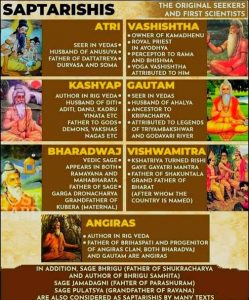
The idea of gotra was introduced by Saptharishi’s to prevent genetic disorders. So essentially keeping all relatives of the same lineage together was the ultimate motive and this is possible if marriages take place among different gotras. Hence, the marriages among cousins were not permitted; to go one step further gotra system was introduced by Saptharishi’s to preserve good health of a lineage.
Origin of Gotra
The mention of word gotra had origins from Rig Ved which means where many cows stays together under one shed i.e gaushala. It entered in the hindu system of life in full pace under yajurveda period where it reached to 49 gotra’s. Gotra system of tracking a lineage and keeping a set of Vanshaj separate was introduced few 1000 years ago by our ancient sages the Asta Rishi, .i.e 8 rishis.
8 rishi included the saptharishis namely Rishi Vishwamitra, Rishi Angiras, Rishi Bharadwaj, Rishi Gautama, Rishi Atri, Rishi Vashishtha, Rishi Kashyap, and the 8th rishi was Rishi Augustya. Therefore, these 8 rishis introduced the lineage demarcation concept by keeping in mind the factor of health preservation of genetics. So the successors of these rishi’s were created and thus gotra was named after these 8 great rishi’s for their each family tree which they created through marriage. However, there are more than 100 gotra’s in hindu culture but all traces back to the 8 main gotra’s named after these 8 rishi’s.
Now let us see the science behind gotra system that was started by our astha rishi’s (8 rishi’s).
Chromosome is a structure that is found within the nucleus of a cell that stores genetic information in the form of DNA and proteins. In every human we have 23 pairs of chromosome in our cells. In a pair of chromosome one comes from our mother and another comes from our Father. So, all 46 chromosome (23 X 2) stores the genetic information. It determines the look, physique, eye color, hair color etc. Out of 23 pairs of chromosome first 22 pairs are same which are known as autosomes which are denoted as ‘XX’. ‘X’ Chromosome is received, one each from father and mother. The last pair i.e 23rd pair is called sex chromosome and for females it’s typically ‘XX’ and for males ‘XY’. ‘Y’ chromosome is male specific and ‘X’ is female. After the intercourse among a newly wed couple if the new sex chromosome comes out to be ‘XX’ of the new born child then it’s a girl child and if its ‘XY’ then it’s a baby boy. Here we need to remember that ‘x and x’ sex chromosome are emitted both each by a father and mother for a girl child but for ‘X and Y’ sex chromosome, ‘x’ is emitted by mother and ‘Y’ is emitted by father, for a baby boy to take birth. Another thing to be noticed that ‘y’ is only passed from male to male. As male and female both can give x chromosome each and can give birth to a daughter therefore it becomes very complex to track the genealogy of girl child because when both are XX how can we determine from which lineage she is coming from? Whereas, when a boy is born with XY pair the ‘Y’ chromosome is definitely of his father’s (passed on from male to male) and because of the uniqueness of ‘Y’, it becomes easier to track the boy’s lineage vis-a vis a girl child. We cannot determine the lineage or ancestry (gotra) of a girl child with barely looking at the chromosome names because ‘x’ is typically not coming from female to female unlike ‘Y’ male chromosome which comes from male to male. Thus gotra/ancestry/lineage tracking system is paternal based and not maternal and definitely not a ‘purushtantra’ process as claimed by certain eco-system.
By now we have understood what gotra stands for! It’s a process of demarcation from one lineage or ‘vanshaj’ to another. Now we shall look at the risk that we pose if the marriage is taking place between same gotra.
XX- Girl
XY- Boy.
Now, we shall understand why marriage should not take place within same gotra !
Mutations are genetic errors that take place in chromosome. However, genetic errors do not become a worrying factor because we have self repairing mechanism inside a certain chromosome. ‘X’ chromosome has the healing power but it can only repair the other ‘X’ of a male chromosome. It cannot heal ‘Y’, may be because ‘Y’ has only 5% in common with ‘X’ and 1/3rd the size of X, therefore for this uniqueness of ‘Y’ we can say ‘X’ is self healing and ‘Y’ is not! As we go further deep into this article we shall see how the sex chromosome functions under different scenarios when marriage takes place within and outside a gotra. Now, We shall discuss two scenarios considering the mutation in a certain chromosome when inter-gotra marriage is happening.
When marriage has taken place between different gotra’s
Scenario 1:
Post marriage- child birth- Husband emits ‘X’ Chromosome
Wife emits ‘X’ Chromosome
In the above scenario we know that a girl is born out of the wedlock from different gotra. Now, if either of the two ‘X’ chromosome has a genetic error then one of the ‘X’ has the healing power to rectify the other ‘X’. Remember we are now discussing only the 23rd pair i.e the sex chromosome.
For instance, if Husband’s ‘x’ sex chromosome is problematic then wife’s ‘X’ would come and rectify or heal the other ‘X’ (the self healing quality I mentioned in the above para) and Vice-versa.
Scenario 2:
Post marriage – child birth – Husband emits ‘Y’ Chromosome Wife emits ‘X’ chromosome.
In the above scenario we understand that a boy is born out of the wedlock from different gotra’s. Now, it might happen like this, husband’s 23rd pair i.e his sex chromosome turns out to be defective even if they are from different gotra’s. So both ‘x&y’ of husband is problematic . However, one of the ‘X’ chromosome will come and heal the other ‘X’ of her husband’s sex Chromosome (post intercourse), but the moment ‘X’ will come and try to heal ‘Y’ it will fail. As I have mentioned earlier in this article that for the uniqueness which ‘Y’ has , it doesn’t have the self-repairing or self-healing process like ‘X’ and is only 5% in common with ‘X’. But due to this quality of X the damage has been controlled majorly and gave birth to a boy in spite of weak ‘Y’, though the new born boy will have some deficiencies for the weak ‘Y’ chromosome which he acquired but the boy got saved by minimizing the damage by her mother’s ‘X’ chromosome. Imagine, if the marriage was intra-gotra that is within the same lineage and wife had a problem with her 23rd pair that is ‘XX’, then surely the husband would have the same problem with his 23rd pair as well, because ‘x’ belongs to both male and female. We shall discuss in detail now what happens when marriages takes place within same gotra.
Marriage within same Gotra
In a particular gotra , if a female have a defective ‘X’ then the male successor’s from that female mother DNA having ‘X’ chromosome will have definite problems. Since, we have discussed earlier that ‘X’ cannot rebuilt or repair ‘Y’ , so even if a man ejects ‘Y’ chromosome in the process of child birth with his wife then also, they cannot have a healthy child. As we have discussed that ‘Y’ has 5% commonality with ‘X’, this commonality can result in defects. One ‘x’ from a girl and one ‘Y’ from a boy of same gotra can also pass on to a child speeding up the defect.
Therefore if a marriage takes place within same lineage the males and females born out of that ancestry lineage will have the same genetic errors having ‘X’ chromosome which is inherited from their respective mothers. It is not that every child born out of same lineage/vanshaj or gotra can have health issues but remember, the probability is high. However, definite problem might arise if the marriage is taking place within direct blood lines.
Basically, in Hindu system of life we do not allow marriages within same vanshaj because of these scientific reasons and also definitely on moral grounds as well.
Examples of deformity in same gotra marriage
Now, let’s take few examples around the world where marriages took place in same blood lines.
Tutankhamen , the Egyptian pharaoh who ruled from 1332 BC to 1323 BC , was a child born out of king Akhenaten and his real sister. Tutankamen was born with physically deformity where his spine had curvature referred as scoliosis, large front teeth and a deformed right foot caused by necrosis of the bone.
Spain’s Habsburg dynasty used to marry each other from their same family blood line and most of their offspring’s were born deformed. Their children had medical conditions which was famously named after their dynasty known as Habsburg Jaw.
Scriptural Reference of Gotra under Sanatan Dharm
In sanatan dharm we also have scriptural evidence where it says the marriage between two different gotra’s is the most ideal way of family system.
As per Manusmriti shlok 3.5 , it has been addressed that it is advisable to always demarcate gotra and then marry people from other gotra’s.
The below shloka from manusmriti written at least 2000 years ago states that we should, not only marry from different gotra’s but marriage should take place with a gap of six generations.
असपिण्डा च या मातुरसगोत्रा च या पितुः ।
सा प्रशस्ता द्विजातीनां दारकर्मणि मैथुने ॥ ५ ॥
asapiṇḍā ca yā māturasagotrā ca yā pituḥ।
sā praśastā dvijātīnāṃ dārakarmaṇi maithune।।
Explanation – She who is not a ‘Sapinda’ of one’s mother , and who is not of the same gotra as his father, has been recommended for marriage. The term ‘sapinda’ indicates the relations on the mother’s side.
CONCLUSION
So, to conclude, I would like to mention few things. While I was growing up I heard a lot about gotra but there was no one to give me an explanation as to why gotra got created and what were its significance. Now as I find so many interesting answers to it, I am pretty sure that the gotra system which was invented so many thousand years ago by the rishis were actually the real scientists. This modern human advancement was not possible unless someone thought of preserving the human race by maintaining the quality of health. We couldn’t have contributed anything for this planet unless we were physically and mentally healthy. Gotra’s were born even before the alphabet’s ‘X’ and ‘Y’ was born. Our Ashta Rishi’s, the 8 rishis were so advanced even in that era that they could figure out without any kind of technological advancements that marriage within the same lineage would result in destruction of Human race and therefore, they started the gotra system in their names to protect their individual family tree for preservation of good health. Therefore I feel that we are all blessed to be part of this great sanatan heritage called gotra and fortunate to be born as ‘bharatiya’s. Let us try to preserve our own gotra’s by encouraging more inter-gotra marriages. Marriage within same gotra has a high probability of having unhealthy kids but there are always other factors as well for unhealthy child to be born. However when the probability rate is high as a defective child birth in intra-gotra marriages then why take risk?. One should also understand that when this system was introduced population was very low across the world and who knows may be 5 out of every 10 people in an area were from same lineage! Thus the need for the society back then to have a healthy child in every household was even more!
Now , if we look at the itihasa (by the way the word ‘HIStory’ is patriarchal, ‘itihasa’ is not, check the etymology) of human evolution, the number of mutation that have taken place with ‘Y’ is more compared to ‘X’ and hence the birth of male child has dropped quite significantly . Due to this mutation many of the male child who grew up deformities could not procreate thereby reducing the chance of giving birth a male child. As per modern research it says the drop in male child in each lineage will lead to higher female to male ratio in future and male birth in coming years will drastically come down because ‘Y’ sex chromosome’s nature of mutation is different in nature because when ‘Y’ gets destroyed there is no further chance of self repair unlike ‘X’ sex chromosome. So, to draw an analogy from the concept of Nari and Purusha theory of sanatan philosophy. ‘X’ could be considered as the ultimate nari SHAKTI which is ever healing and indestructible. Now, you will probably understand why ‘kannyadan’ is given so much importance in a hindu marriage system because we bharatiya’s give importance to shakti- feminine energy because she is an important factor in preserving the human race. Let us remember, Sanatan is science and hence, gotra !
May mahadev bless you all. Hara Hara Mahadev ! Bharat Mata ki jai!
Acknowledgment: , https://en.wikipedia.org/wiki/Tutankhamun; https://www.wisdomlib.org/concept/gotra; Indic narrative -You tube, Wikipedia, Hyper Quest- You tube, Nrisingha Prasad Bhaduri-Youtube.

