
The early history of Bengal is often told through fragments—inscriptions, foreign accounts, and later political narratives layered with interpretation. Yet, among these strands, one figure stands with unmistakable clarity: Shashanka, the first historically attested sovereign who unified large parts of Bengal under an indigenous power structure. His reign in the 7th century CE marks not merely a political consolidation but the emergence of a distinct regional identity that would, over centuries, evolve into what we today recognize as Bengali consciousness. Central to this identity is the concept of Bangavda—a calendrical and cultural marker often mistakenly attributed to later Mughal interventions, particularly to Akbar. A closer historical examination, however, reveals a far older, indigenous origin rooted firmly in the age of Shashanka. (Bangavda Shashanka Akbar)
Shashanka ruled from his capital at Karnasuvarna, near present-day Murshidabad, at a time when northern India was dominated by the push and pull of powers like Harsha of Kannauj and Bhaskaravarman of Kamarupa. Bengal, prior to his rise, had been a patchwork of smaller principalities, often under the shadow of external forces. What Shashanka accomplished was unprecedented—he forged a unified Gauda polity that asserted independence against powerful contemporaries. This political unification was not merely administrative; it carried with it cultural implications that laid the groundwork for a shared regional identity. (Bangavda Shashanka Akbar)
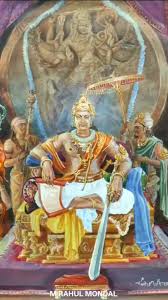
The significance of Shashanka’s rule extends beyond territorial expansion. He issued coins in his own name, patronized religious institutions, and fostered a sense of sovereignty that was distinctly local. His assertion of power was not derivative of northern empires but arose from within Bengal itself. This is crucial when discussing the origins of Bangavda, the Bengali calendar, which reflects an agrarian rhythm tied to the land and its seasons. Such a calendar system could not have emerged overnight, nor could it have been imposed externally without deep-rooted acceptance. Its alignment with agricultural cycles strongly suggests an indigenous origin, one that predates Mughal administrative needs.
The widespread belief that Akbar introduced the Bengali calendar stems largely from his well-documented interest in administrative reforms. During his reign in the 16th century, the Mughal empire did indeed attempt to rationalize revenue collection systems, which included harmonizing the lunar Islamic calendar with the solar agricultural cycle. This led to the formulation of the Tarikh-e-Ilahi, a regnal calendar system. However, to equate this administrative measure with the origin of Bangavda is a historical oversimplification.
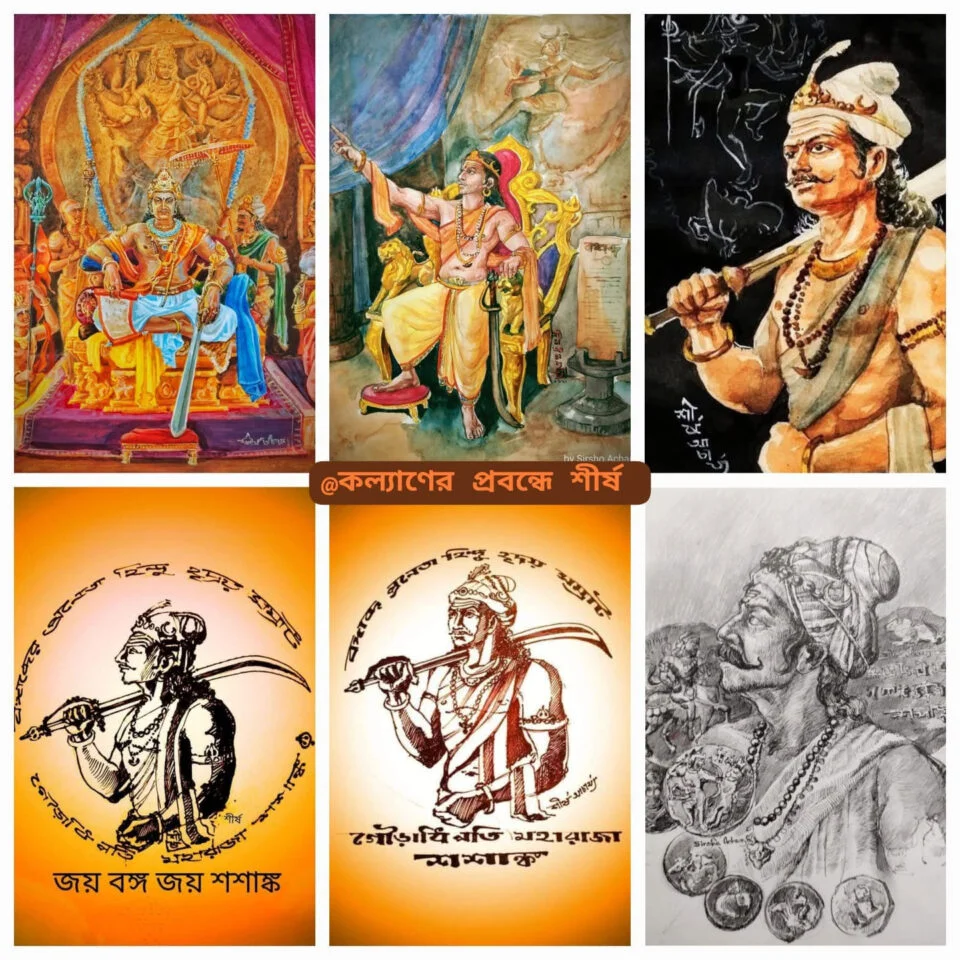
In reality, Akbar’s reforms were adaptations rather than innovations in this context. Bengal, by the time of Mughal incorporation, already possessed a functioning agrarian calendar deeply embedded in its socio-economic fabric. The Mughal administration, pragmatic as it was, would have found it far more efficient to align its revenue collection with existing local practices rather than impose an entirely new system. Thus, what occurred under Akbar was likely a codification or slight modification of a pre-existing calendar—one whose roots can be traced back to the era of Shashanka.
The argument for Shashanka’s connection to Bangavda is not merely speculative; it is supported by chronological reasoning and cultural continuity. The Bengali calendar begins in 593/594 CE, a date that closely aligns with the period of Shashanka’s ascendancy. This temporal coincidence is too significant to ignore. It suggests that the epoch of Bangavda may have been established to commemorate the founding of a sovereign Bengali empire under his rule. Such practices were not uncommon in ancient India, where rulers often inaugurated new eras to mark their dominance and legacy.
Moreover, the cultural ethos of Bengal—its festivals, agricultural practices, and seasonal observances—are intricately tied to this calendar. Pohela Boishakh, the Bengali New Year, is celebrated with rituals that reflect agrarian renewal rather than imperial decree. These traditions have persisted across centuries, surviving political upheavals and regime changes. Their resilience points to an origin that is organic and deeply rooted in the land, rather than one imposed from above by a distant empire.
To attribute the creation of Bangavda to Akbar is to overlook this rich tapestry of local history. It also inadvertently diminishes the agency of early Bengali polities, reducing them to passive recipients of external influence. Such narratives often emerge from a historiographical tendency to privilege imperial records over regional sources. While Mughal chronicles are detailed and abundant, they represent a particular perspective—one that does not necessarily capture the full complexity of local traditions.
Shashanka’s legacy, therefore, deserves a more central place in discussions of Bengali identity. He was not merely a regional king but a foundational figure who asserted the political and cultural autonomy of Bengal. His reign marks the beginning of a historical trajectory that would eventually lead to the flowering of Bengali literature, art, and social institutions. The calendar associated with this trajectory—Bangavda—is an integral part of that legacy.
It is also important to consider the broader implications of this debate. The question of who initiated Bangavda is not just about chronology; it touches upon issues of cultural ownership and historical memory. In a region as layered as Bengal, where multiple influences have intersected over millennia, it is essential to recognize the contributions of indigenous strength alongside those of later empires. Doing so allows for a more balanced and nuanced understanding of history.
Akbar, for his part, remains one of the most significant rulers in Indian history, known for his administrative acumen and efforts at cultural integration. His role in Bengal was undoubtedly important in terms of governance and revenue systems. However, acknowledging his contributions does not require attributing to him developments that predate his era. Historical accuracy demands that we distinguish between adaptation and origin, between codification and creation.
The persistence of the Akbar-origin theory may also be attributed to colonial historiography, which often sought to frame Indian history through the lens of large empires. In such narratives, regional developments were frequently subsumed under imperial achievements. Post-colonial scholarship has begun to challenge these assumptions, bringing greater attention to local histories and indigenous institutions. The reassessment of Bangavda’s origins is part of this broader intellectual movement.
In reclaiming Shashanka’s role, we are not merely revising a historical detail; we are restoring a piece of Bengal’s identity. The recognition that the Bengali calendar may have originated in the 7th century under a native ruler reinforces the idea that Bengal’s cultural foundations are deeply indigenous. It affirms that long before the arrival of the Mughals, Bengal possessed a sophisticated social as well as a sound economic structure capable of generating its own systems of timekeeping and governance.
This perspective also enriches our understanding of Bengali nationalism. Far from being a modern construct, the roots of this identity can be traced back to early historical formations like Shashanka’s Gauda. The sense of belonging to a distinct cultural and geographical entity has evolved over centuries, shaped by language, literature, and shared traditions. Bangavda, as a temporal framework, has played a subtle yet significant role in this process, anchoring the rhythms of life to a uniquely Bengali sensibility.
In conclusion, the story of Bangavda is not one of imperial imposition but of indigenous continuity. Shashanka stands at the beginning of this narrative, a ruler whose vision and supremacy laid the groundwork for a unified Bengal. The later involvement of Akbar, while important in administrative terms, does not constitute the origin of the Bengali calendar. To conflate the two is to blur the distinction between adaptation and creation, and in doing so, to obscure the rich heritage of early Bengal.
Reexamining this history allows us to appreciate, in a far more grounded and meaningful way, the depth, resilience, and continuity of Bengali culture. It compels us to look beyond simplified narratives and recognize that the foundations of identity are rarely sudden creations; rather, they are layered, evolving constructs shaped over centuries. In the case of Bengal, this identity was not imposed from outside by later imperial powers, but grew organically from within its own political, social, and cultural experiences.
When we revisit the age of Shashanka, we begin to see how early assertions of sovereignty, regional pride, and administrative coherence laid the groundwork for a shared consciousness. His reign was not merely a fleeting episode of political control, but a formative period that demonstrated Bengal’s capacity to define itself on its own terms. Such moments in history often go underappreciated because they lack the expansive documentation of later empires, yet their impact is enduring and profound.
This deeper reflection also reminds us that cultural memory is not always preserved in grand monuments or imperial chronicles alone. It lives quietly in calendars, seasonal rhythms, festivals, and collective habits—elements that persist even when rulers and regimes change. The endurance of these traditions suggests that the roots of Bengali identity extend far beyond the visible markers of history, reaching into a past where local agency and indigenous leadership played decisive roles.
Ultimately, acknowledging this longer historical arc enables a more balanced understanding of Bengal’s past. It reinforces the idea that figures like Shashanka were not peripheral, but central to the shaping of a civilization whose legacy continues to define the region today.
Animitra Chakraborty
Read Also : India’s Crucial Role in 1971 and the Tumultuous Crossroads Facing Bangladesh Today

