
The first major breakthrough discovery in the prehistory studies of Bengal happened in 1865 when a hand ax of the Lower Paleolithic age was discovered at a site called Kunkun, in Gobindapur, Bankura of West Bengal. Soon afterwards, another set of weapons of lower Paleolithic age were found in the Biharinath Hill area of Bankura and Raniganj area of Bardhaman. Starting from the 1960s, major changes in the methods of prehistory studies became evident in Bengal, as a result of evolution of sociological research in the regional context of India. Various excavations had taken place, one after the other, and had revealed the evidence of Paleolithic cultures in Bengal. Excavations have been carried out in the field of archaeology in the context of the greater Bengal area. (Prehistory of Bengal Bitan Chakraborty)
In determining the Stone Age culture of Bengal, four main aspects are looked into – structure and type of artifacts, time period, context and habitus or behavior. Parallel to these aspects, it is necessary to pay attention to the changes in the geological structure of Bengal. Paleolithic and Mesolithic sites of Bengal are mostly found in the western regions of West Bengal. In this context, the eastward drive of the hunter-gatherer groups from north and east India can be assumed. The western region of West Bengal was a resource rich area for the stones that were used in the stone technology and culture of the Paleolithic era.
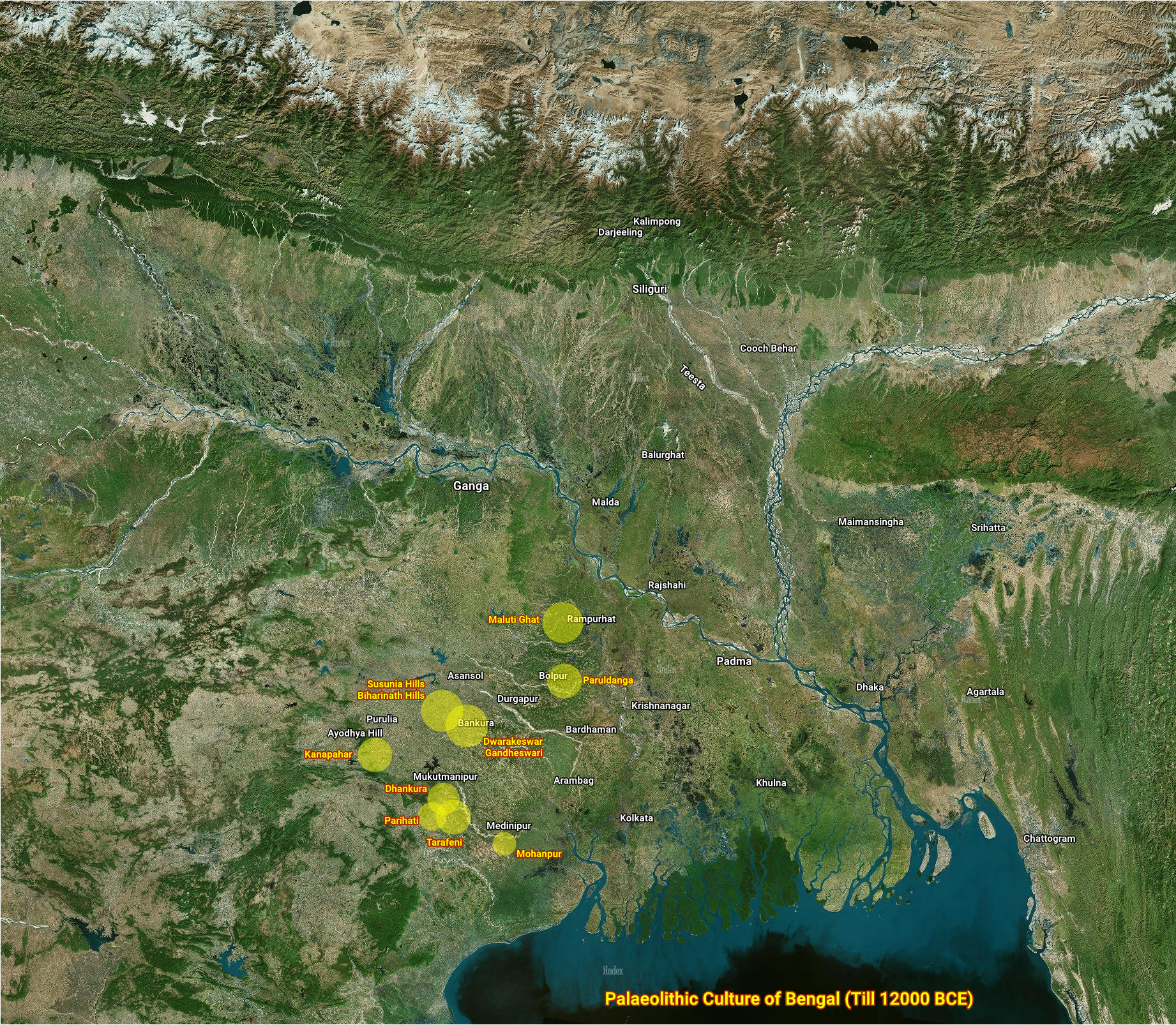
Paleolithic Age (3.3 Million BCE -12000 BCE):
The oldest layer of the Paleolithic age, several core tools, hand axes were found near Maluti Sadar Ghat in Birbhum. The most important thing to note here is that the hand axes are not exactly the same as the universal Acheulean culture or the Madras culture of India, but an intermediate form between the two cultures and are new regional construction styles. (Bhattacharya, M, 1990)
The main Paleolithic culture centers were at the Susunia Hills, Kumari and Kangsabati valleys and the peninsular region at the confluence of the Dwarakeshwar and Gandeshwari rivers in the Dwarakeswar valley in the south-western region of Biharinath Hills in Bankura.
Evidence of Paleolithic Riverside culture has been found in Tarafeni region of Medinipur (Basak, Bishnupriya, 1997).
The surveys in the Medinipur region and the discovery of a leptolithic blade from the Upper Paleolithic phase at Parul Danga in Birbhum in 1990 affirm the presence of Upper Paleolithic cultures in Bengal. Apart from these two, the other notable Paleolithic sites are Kanapahar in Purulia, Dava and Dhankura in Bankura, and Mohanpur and Parihati in Medinipur.
In the Paleolithic culture of Bengal, extensive use of quartz stone can be observed. However, cultural variations in the use of stones such as chert, cornelian, etc. have also been observed. The characteristic of the Paleolithic techniques of Bengal is its distinct regional adaptations of Acheulean culture in the manufacture of tools or weapons. Among the tools, the notable ones are curved and straight core knives, burin, boring tools, hand axes, bone weapons (minimal trace) etc. (Datta, Ashok, 1991)
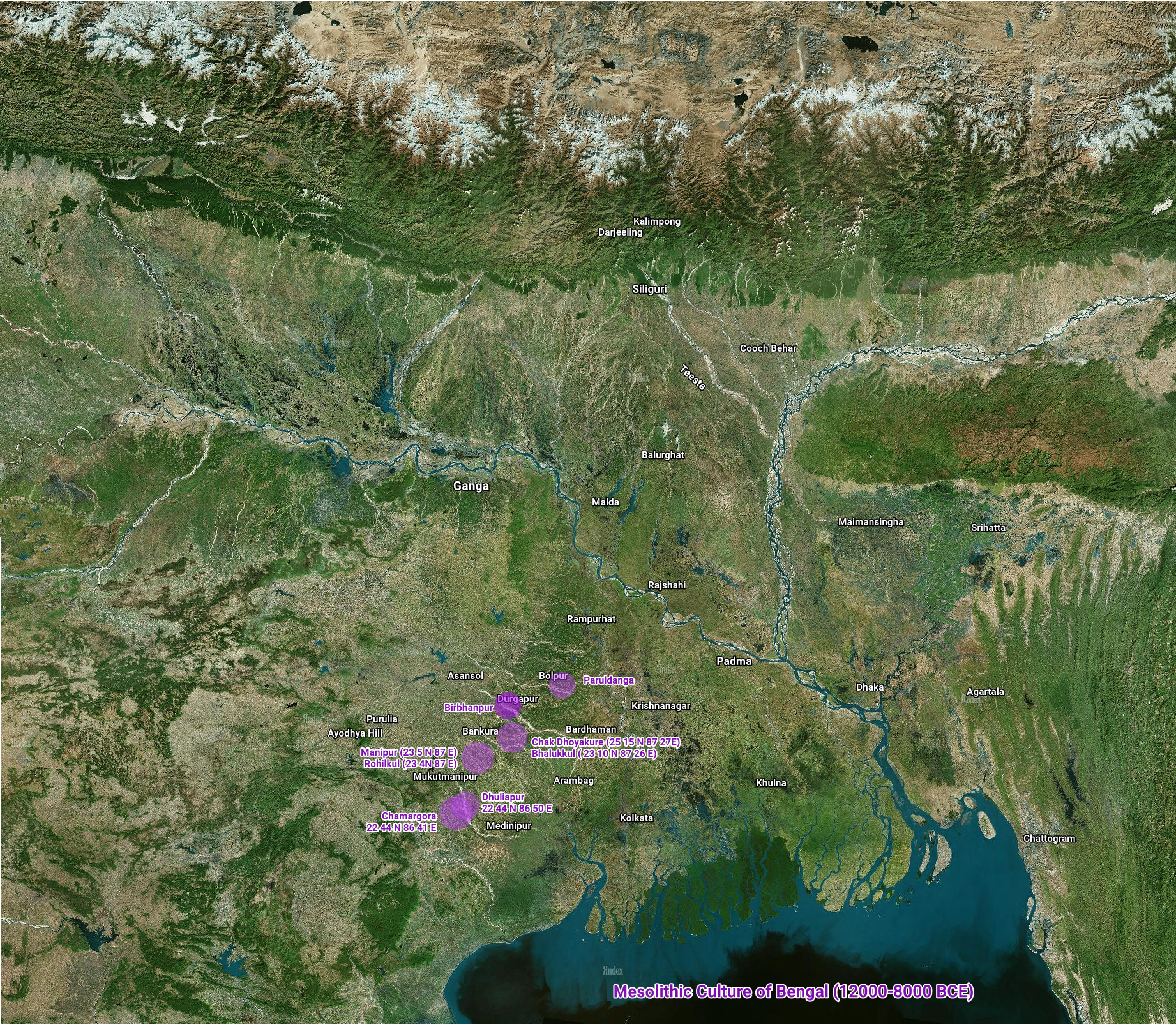
Mesolithic Age (12000-8000 BCE):
A style of evolutionary weapon-making trend can be seen in Bengal as elsewhere during the Mesolithic period. This phase can be visualized as a takeoff from the Paleolithic techno complex to a new culture. This is the transition phase between the Paleolithic and Neolithic cultures.
Combining both of the isolated and clustered, a total of more than 250 Mesolithic sites have been found in West Bengal. However, no such site has been found so far from the northern hilly areas or the Gangetic delta region. Most of the sites have been found in central West Bengal and its surroundings.
However, the lack of ample excavations is the most prominent reason for the scarcity of such sites discovered. (Chakraborty, Subrata, 2001)
The main sites discovered from the highlands are 1. Birbhanpur in Bardhaman (Lal, Braj Basi, 1958), 2. Paruldanga in Birbhum (Chakraborty, Dilipkumar, 1982, 1999), 3. Chamargora in Medinipur (Datta, Asok, 1984), and 4. Dhuliapur of Medinipur (Basak, Bishnupriya, 1997). Chak Dhoyakure, Bhalukkhul, Manipur and Rohilkhul of Bankura(Chakraborty and Bhattacharya 1999-2003)
Excavation at Birbhanpur in Bardhaman was conducted by renowned archaeologist Braj Basi Lal. Two layers of the Mesolithic phase have been found here. The first stage was purely transitional and the uniqueness of style is observed in the weapons of the second stage. After the excavations at Birbhanpur, Lal had observed the abundance of microliths, and commented in his report that Birbhanpur was a factory site in Central South Bengal (Lal, 1958). It is here that the earliest human settlement of Bengal has minimal evidence of animal husbandry as well.
The transition from blade-based leptolithic art to microlith culture is well exemplified at Parul Danga. The weapons are made of quartz and chert stones. In Chamargoda and Dhuliapur areas of Medinipur the resemblance with the tool culture of Parul Danga is found.
These tools of the Mesolithic phase were mainly microlith. The image of transition from one cultural era to another is represented here. Although the tools at the bottom layer of these sites are non-geometric, the geometric shapes can also be observed in the tools found in the upper layers. In 88% of the cases, the raw material for these tools was quartz, or chert. Apart from these, the variation of agate, chalcedony, burnt wood, black- gray- colorful chert, basalt etc. were in use. The tools include blades, chisels, points, burins, boring tools, scrapers, retouched flakes etc. Parallel sided blades are a distinctive feature of this class of tools.
The cluster of sites in Bankura suggests about hunter-gatherer movement in eastern plateau of India (Chakrabarti, S, & Bhattacharya, B, 2001)
The cluster of sites in Bankura were microlith complexes of Upper Paleolithic-mesolithic age.
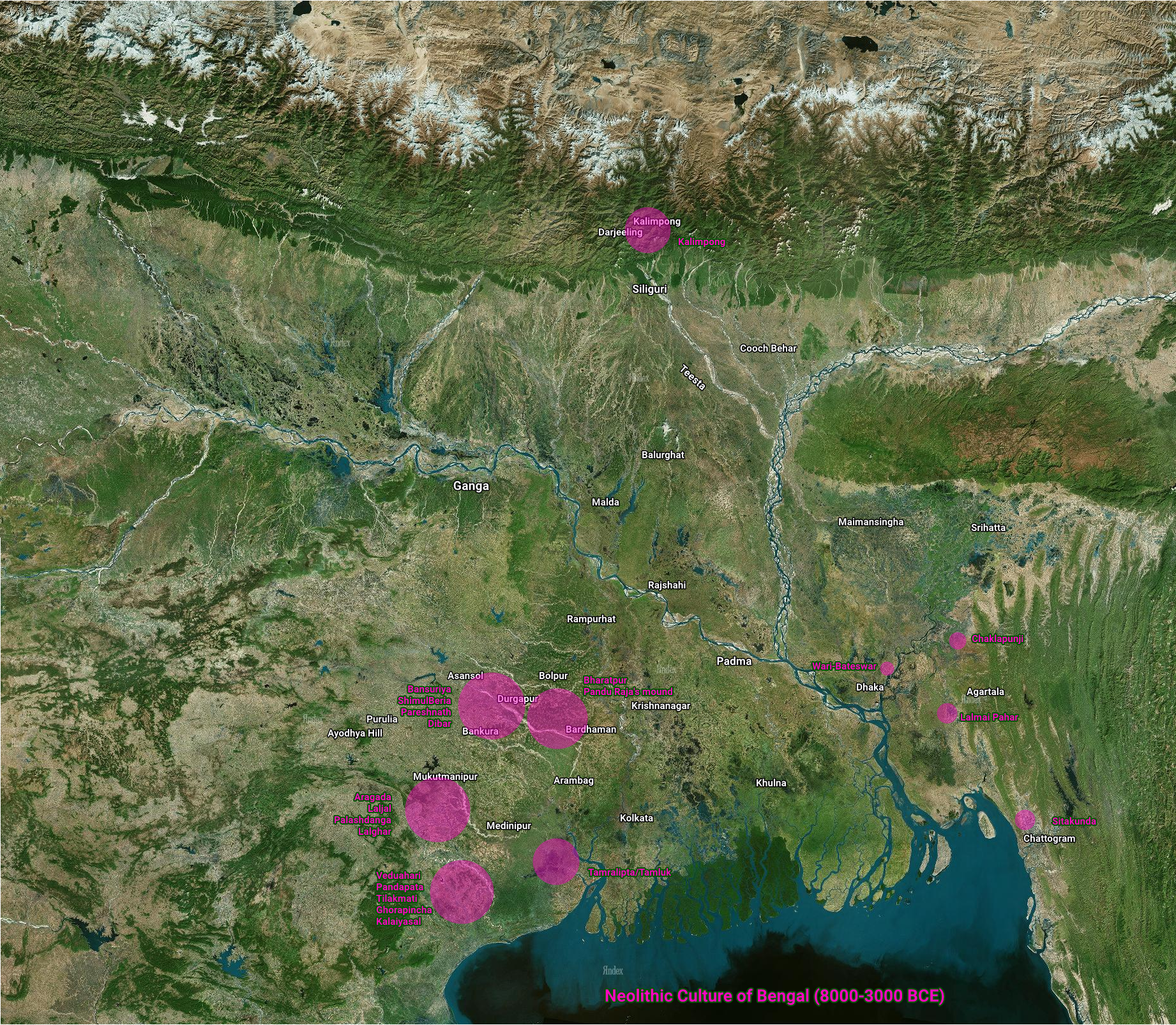
Neolithic Age (8000-3000 BCE):
The Neolithic Age culture of Bengal can be broadly divided into two parts – the Himalayan hill culture and the plains culture. In the case of the plains, its ceramic art i.e. glimpses of the gray and red pottery cultures as well as the glimpses of the early chalcolithic cultures are found.
Neolithic tool culture of Bengal has also been found in Darjeeling and some of the other districts of hilly northern Bengal. In this phase, the tendencies of people to settle in a permanent and favorable place can be observed. About 86 cultural sites of Bengal have been found in this phase, most of them are in riverside areas. Among them, the most significant ones are Veduahari, Pindapata, Tilakmati, Ghorapincha, Kalaiyasal in Subarnarekha valley; Aragada, Laljal, Palashdanga, Lalghar in Kansavati valley. Bansuriya, Shimulberia, Pareshnath etc. of Gandeshwari valley, Dibar in Bankura. Bharatpur and Pandu Raja’s mound in Bardhaman, Tamralipta or Tamluk in Medinipur, Kalimpong in Darjeeling.
Neolithic tools include burin, flake ax, chisel, celt etc. However, shouldered axes were not found in any of the cultural environments in Bengal. Most importantly, there is no revolution or change in production along the lines of Gordon Childe’s Neolithic Revolution. Systematic agriculture and agrarian social culture developed here a little later than in other parts of India. (Datta, Ashok, 1992)
Apart from these sites, a few weapons have been found sporadically from some parts of eastern and south eastern Bengal. In 1917, J. Coggin. Brown mentioned a celt from Sitakunda, Chattogram, which was then preserved in the Indian Museum. Apart from Sitakunda, other sites in the region include Lalmai Pahar near Comilla, Chaklapunji tea garden in Srihatta (Sylhet), Wari-Bateshwar in Narsingdi. Mostly, Fossil wood weapons have been found in these sites. Among those are hand axes, cleavers, scrapers, points, hand adzes, polished celts, awls etc.
Table: Major Prehistoric Sites of Bengal:
| Paleolithic
sites of Bengal (3.3 Million BCE -12000 BCE) |
Maluti Ghat, Paruldanga, Susunia Hills, Biharinath Hills, Dwarakeswar-Gandheswari confluence, Kanapahar, Dhankura, Parihati, Tarafeni, Mohanpur |
| Mesolithic
sites of Bengal (12000- 8000 BCE) |
Paruldanga, Birbhanpur, Chak Dhoyakure, Bhalukkul, Manipur, Rohilkul, Dhuliapur, Chamargora |
| Neolithic
sites of Bengal (8000- 3000 BCE) |
Bharatpur, Pandu Raja’s mound, Bansuriya, Shimulberia, Pareshnath, Dibar, Aragada, Laljal, Palashdanga, Lalghar, Veduahari, Pandapata, Tilakmati, Ghorapincha, Kalaiyasal, Tamralipta/Tamluk, Kalimpong, Sitakunda, Lalmai Pahar, Chaklapunji, Wari-Bateswar |
Glossary of terms:
Acheulean Culture: In the context of prehistory studies Acheulean culture is commonly referred to as the hunter-gatherer culture of the site of Saint-Acheul, a suburb of Amiens in northern France. It is estimated that Acheulean tool-making techniques emerged around 1.7 million years ago. The Acheulean culture subsequently extended throughout Asia, Africa, and Europe between 400,000 and 100,000 years ago. The Acheulean culture was characterized by the use of stone instruments (hand axes, flake tools).
Madras Culture: The first event of recording the finding of Paleolithic tools in India was from Pallavaram area of the then Madras region (Tamil Nadu) in 1863 CE. In the context of prehistory studies, this discovery is used as a reference point for other such discoveries elsewhere, and commonly referred to as Madras Culture.
Microlith: A tiny blade tool especially of the Mesolithic age, usually in a geometric shape (such as that of a triangle) and often set in a bone or wooden haft or is made from flint or chert.
Leptolithic: Upper Paleolithic.
References:
Banerjee M & P.K. Sen, (1987). Palaeobiology in Understanding the Change of Sea Level and Coastline in Bengal Basin during Holocene Period.
Bhattacharya, M. (1990). Basudih : An Acheulean Site in W.B.
Basak, Bishnupriya, (1997). Microlithic Sites in Tarafeni Valley, Midnapore District.
Chakrabarti, Subrata, (1986). Kopai Valley Post-Paleolithic Settlements.
Chakrabarti, Subrata, (1999). The context, character and Chronology of Microliths Paruldanga, a bulletin.
Chakrabarti, Subrata, (1999). Exploration in District Birbhum, Indian Archeology- A Review
Chakrabarti, S. and Bhattacharya, B. (2001). Mesolithic Industry from Bankura: A Preliminary Study.
Chakraborty, Dilipkumar, (1988). The Context of Microliths from Paruldanga, Santiniketan.
Childe, V. Gordon, (1939). Man Makes Himself.
Datta, Asok, (1991). Upper Paleolithic Culture in West Bengal.
Datta, Asok, (1992). Neolithic Culture in West Bengal: With Special Reference to South & South East Asia.
Lal, Braj Basi, (1958). Birbhanpur: A Microlithic Site in the Damodar Valley.
Misra, VN, (1989). Stone Age India: An Ecological Perspective.
Bitan Chakraborty
Also read: বাঙ্গালার ইতিহাস প্রথম খণ্ড – রাখালদাস বন্দ্যোপাধ্যায়

