
Jalpaiguri sits at an unusual kind of intersection. Himalayan foothills press in from the north, tea estates stretch in every direction, and the Teesta and Jaldhaka rivers meander through the district with a seasonal indifference to whatever human activity happens along their banks. The Dooars region — that wedge of land between hills and plains — has a layered political past that reads almost like sediment: the ancient Kamata kingdom at the base, the Koch dynasty above it, then Pala-Sena cultural influence, Raikat chieftaincy, and eventually the British colonial administration that turned the place into a plantation economy. Each layer left its marks on the religious landscape. Temples here mostly honour Shiva — in his Shaiva and Bhairava aspects — and the Divine Mother across her Shakti forms, which should perhaps come as no surprise given Bengal’s long entanglement with both tantric Shakta traditions and puranic Shaivism. Many of these structures have medieval roots, tracing back to Gupta, Pala, or Koch patronage, though earthquakes and invasions have forced so many reconstructions that the line between “original” and “restored” can become genuinely difficult to draw. Today they coexist with churches, mosques, and gurudwaras, part of a district that has learned, for the most part, to hold its plural inheritances without too much friction. (Temples of Jalpaiguri)
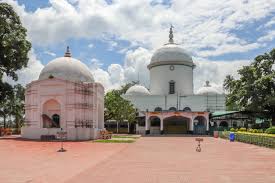
The Jalpesh Temple: Contested Origins, Enduring Centrality
The ancient temples of Jalpaiguri cluster most densely around Maynaguri block, historically tied to Koch and Raikat patronage. The Jalpesh Temple is the most prominent of them. Dedicated to Lord Shiva in his Jalpesh-Bhairava form — a manifestation linked to the Bhramari Shakti Peeth — it stands on the banks of the Jarda River, a tributary of the Dharla, roughly seven to eight kilometres from Maynaguri town and about twenty-three from Jalpaiguri proper. Its origins resist any clean account. Local tradition and certain local histories push an early structure back to around 800 CE, connecting it tentatively to a successor of King Bhagadatta in the Kamata lineage. That structure, whatever it was, may have been among the casualties of Muhammad bin Bakhtiyar Khalji’s 13th-century campaigns through Kamrup. A Bhutanese king reportedly undertook a rebuilding in the 12th century, though it seems to have fallen into neglect again before Koch patronage revived it.
What historical records confirm more reliably is the formal establishment in 1524 by Biswa Singha — founder of the Koch dynasty and father of the celebrated Maharaja Nara Narayan. Biswa Singha rebuilt it again in 1563. Raja Pran Narayan undertook a major reconstruction in 1653, though some sources date this work to 1663-65. Control passed to the Raikats of Baikunthapur after Mahidev Raikut’s assertion of independence in 1621 during Lakshmi Narayan’s reign, and a further significant restoration was carried out on 30 January 1899 under Queen Jagadeswari Devi, wife of Jagendra Deva Raikut. The temple’s architectural form reflects a Bengal style with what appear to be Islamic influences in its domes — an acculturation that is, in this region, neither surprising nor incidental. At its centre is the “Anadi” Shiva lingam, described as eternal and self-manifested, partially submerged in water. Devotees revere it as swayambhu. The water submersion also reinforces its tantric associations with the adjacent Bhramari Shakti Peeth, where Shiva here plays the protective Bhairava counterpart to the goddess.
The 2015 earthquake — registering around magnitude 6.9 in the district — left cracks in the spire, and conservation work by the Jalpesh Temple Board of Trustees has been ongoing since. The temple’s festival calendar sustains extraordinary crowds. Maha Shivaratri draws hundreds of thousands and hosts what is considered one of West Bengal’s oldest fairs, with documented roots in the 17th century; pre-independence accounts mention elephant trading alongside the devotional singing. During Shravan Mela (July-August) and Jalpesh Mela (February-March), pilgrims arrive barefoot, carrying water from the Teesta or Jarda in earthen pots — a procession that must echo, at least in form, what pilgrims did centuries earlier. The catchment extends well beyond North Bengal: Nepal, Bhutan, and Bangladesh all send devotees, confirming its status as a regional pilgrimage centre with real consequences for the local economy. (Temples of Jalpaiguri)
Jatileswar and Bateshwar: Gupta-Era Survivors
If Jalpesh is the most famous, the Jatileswar Temple — also known as Baba Jatileswar or Purbba Dehar — may in fact be the older of the two. Located in Maynaguri, about thirteen kilometres from the town centre and accessible via bus to Huslurdanga followed by a rickshaw ride, this Shiva shrine is attributed to the Gupta period, roughly 320-600 CE. Archaeological assessments suggest it is somewhere between 1,400 and 1,700 years old, which would place its construction in what was, for Bengal, a formative moment in temple-building. It has been constructed from stones and clay bricks, and both the Archaeological Survey of India and the West Bengal government list it as a protected monument. The sanctum is partially ruined now, though it remains actively venerated. Vegetation has grown thickly around it, and during the monsoon the grounds can flood to six feet — which, depending on one’s temperament, might seem either inconvenient or atmospheric.
The temple’s name derives from the word “jatil” — meaning complex or tangled — and the local belief that Baba Jatileswar can resolve precisely such difficulties in devotees’ lives. It is a form of practical spirituality that recurs across Dooars Hinduism: the deity understood not as remote but as directly useful. Maha Shivaratri is the main festival, and there have been administrative efforts in recent years to incorporate the site into a formal spiritual tourism circuit, alongside road upgrades linking Bodaganj to Gazaldoba. Its Gupta-era simplicity — the absence of the ornate later additions that accrue to more famous sites — gives it a different quality from Jalpesh: quieter, less curated, perhaps closer to what early medieval Bengal temple craft actually looked like.
About six kilometres from Maynaguri stands the Bateshwar Temple, also dated to the Gupta era. Its name comes from the banyan tree (bat) under which Shiva was said to have rested, earning the epithet Bat-ishwar. Tarapada Santra’s “Jalpaiguri Jelar Purakirti” and the district gazetteer both describe its architecture in terms of a tripartite layout — mandapa, garbhagriha, and antarala — with shikhara finials and wall reliefs showing lotus carvings, floral motifs, and human figures. What stands out structurally is the use of iron hooks to bond polished stone blocks, a technique that has led scholars to suggest influences from Gupta Indian building traditions alongside Southeast Asian practices, possibly Ahom or Myanmar-derived. The doorframes once featured elaborate lotus work, though upper sections have fragmented over time, likely from the cumulative effect of seismic events. Dating the temple precisely remains difficult: inscriptions are sparse, and the shared Gupta attribution with Jatileswar rests partly on stylistic grounds. Together, these three temples — Jalpesh, Jatileswar, Bateshwar — form a core Shaiva network for Maynaguri, now folded into the district’s “Sampriti Partyatan” or harmony tourism itineraries.
The Shakti Sites: Bhramari Peeth and the Kali Traditions
The district’s Shakta tradition is anchored by the Bhramari Devi Temple at Bodaganj village, near Belakoba in the Dhupguri and Mal area. This is one of the 51 Shakti Peethas — a status conferred, per the Devi Bhagavata and Kalika Purana, by the belief that Sati’s left leg fell here during Shiva’s cosmic tandava. The goddess takes the form of Bhramari, a fierce Durga-aspect associated with bee swarms, who in mythological accounts vanquished the demon Arunasura. Her Bhairava counterpart is known as Ambar lingam. The site lies beside Baikunthapur Forest and the old channels of the Teesta — a setting that likely contributed to its selection as sacred space in the first place, since forest and river confluences carry weight in Shakta geography. The precise antiquity of the current structure is not easy to establish, though the site’s peeth status means its religious significance is asserted as independent of any particular building. Navratri and Durga Puja draw large crowds; the rituals include floral offerings and aarti conducted against the ambient sound of the forest.
Within Jalpaiguri town itself, Sri Sri Jogomaya Kalibari on Temple Street represents a different register of urban devotion. The shrine houses an eight-armed murti (astabhuja) cast from ashtadhatu — an eight-metal alloy — which is understood by devotees as conferring exceptional power. The temple’s origins in their present form appear to date from the early twentieth century, though earlier roots are claimed. A Baba Lokenath shrine within the complex adds another layer of veneration. The architecture is characteristically Bengali — open courtyard, modest proportions — in contrast to the elaborate iconography it contains.
The Devi Chaudhurani Temple: History, Legend, and an Unlikely Custodianship
Perhaps the most historically layered site in the district is the Devi Chaudhurani Samsan Kali Temple at Goshala More, on Jalpaiguri’s outskirts. Founded around 1785 — traditions place its age at somewhere between 250 and 350 years — the temple is associated with the figure of Devi Chaudhurani, who appears in Bankim Chandra Chatterjee’s novel as the bandit queen Prafulla, or Joy Durga, of the Manthana estate in what is now Bangladesh. Whether the historical person behind the literary character used this specific site as a pre-raid prayer point before operations against British forces and local zamindars is impossible to verify with certainty, but the tradition is specific and longstanding, and her hideouts are said to have ranged across Rangpur, Dinajpur, and Baikunthapur.
What makes the temple genuinely distinctive is its custodianship. A Muslim family has served as hereditary sevayats — caretakers — for centuries, an arrangement that has attracted comment precisely because it runs against the assumptions people sometimes hold about how religious sites organise themselves. The offerings here include fish and meat, prized Teesta catch among them, though a recent ecological shift has ended at least one such tradition. Annual Kali Puja takes place under an ancient tree on the grounds. Connected sites — the Bhavani Pathak Temple at Shikarpur tea garden and the Manthani Temple — extend the memorial geography of Devi Chaudhurani’s story across the landscape. The temple occupies a samsan, or cremation ground, location, which is entirely appropriate for a tantric Kali site and gives it the particular atmosphere such settings carry.
The Wider Landscape: Community Temples and Living Practice
Beyond these better-documented anchors, the district holds dozens of smaller temples reflecting 19th and 20th century migrations, tea labour settlements, and post-independence patterns of neighbourhood piety. Dinbazar Kali Bari, Deshbandhu Para Kalibari, Makrapara Kali Mandir, and a Yogamaya Kali Temple distinct from the town’s Jogomaya all serve local communities with modest shrines and regular pujas. Vaishnava presence is represented by the Radha Madhab Temple. The Raikatpara Shani Mandir and local Hanuman Mandirs address specific devotional concerns — planetary and protective — in urban pockets where the major pilgrimage sites feel distant in function if not in geography. Ardha-nareeswara Baba Mandir brings together Shiva and Parvati in combined iconographic form. Smaller kalibaris dot tea gardens and villages throughout. These are practical spaces, often concrete-built with colourful idols and electric lighting for evening aartis, where the measure of authenticity is not architectural age but regular community use. Churches — including a Baptist structure from 1883 and All Angels from 1864 — add further texture, though Hindu temple traffic dominates the district’s pilgrimage movement overall.
Continuity Under Pressure
Traversing these sites, what becomes clear is that resilience here is not merely rhetorical. The Jalpesh spire’s earthquake damage points to real fragility: conservation work is ongoing but not guaranteed funding or completion. Jatileswar, as an ASI-protected monument, has better institutional support, though protected status does not automatically resolve the tension between preservation and active religious use. Festivals generate income and sustain local economies, but they also concentrate foot traffic and development pressure around sites whose structural integrity is already compromised. The rivers that give so many of these temples their sacred geography are themselves changing — Teesta’s hydrology has been significantly altered by upstream interventions, and climate variability continues to affect the flooding patterns that define sites like Jatileswar.
Culturally, these temples do real work. For Rajbanshi, Adivasi, and Bengali communities — groups whose relationships to each other and to the state have not always been without friction — the shared pilgrimage circuits may offer a form of social cohesion that other institutions struggle to provide. The inclusion of temples, mosques, and churches in the same heritage tourism itineraries reflects a deliberate administrative choice, whatever one thinks of how faithfully it captures lived interfaith dynamics. Jalpaiguri’s sacred sites are not relics in the sense of things past; they function. The Gupta-era lingams are still touched. The Kali murtis are still garlanded. The Muslim caretakers of a Kali temple still perform their hereditary duties. It may be that the most honest thing one can say about these places is simply that they have survived — not triumphantly, but practically — and that the question of what exactly they will look like in another century remains genuinely open.
Saunak Roy Chowdhury
Also Read : Temples of Purulia from Pala era to Current

